
Chernetidae
Menge, 1855
Chernetid Pseudoscorpions
Genus Guides
2Chernetidae is a large of pseudoscorpions in the order Pseudoscorpiones, containing over 650 described across 119 . Members are small arachnids lacking a tail and stinger, characterized by prominent pincer-like . The family was established by Anton Menge in 1855. Many species inhabit subcortical environments beneath tree bark and are frequently documented engaging in —attaching to insects such as longhorned beetles (Cerambycidae) for .
Pronunciation
How to pronounce Chernetidae: //kɛrˈnɛtɪdiː//
These audio files are automatically generated. While they are not always 100% accurate, they are a good starting point.
Identification
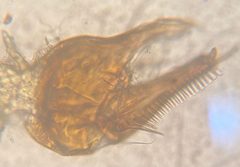
Distinguished from other pseudoscorpion by chelal (pincer) patterns and (sensory hair) arrangement on the . Requires microscopic examination of leg segment counts, setal patterns, and genital structures for - and -level identification. Differs from Cheliferidae in having a more compact body form and specific trichobothrial formulas.
Images
Appearance
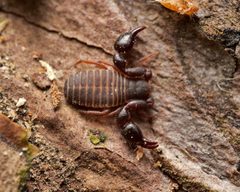
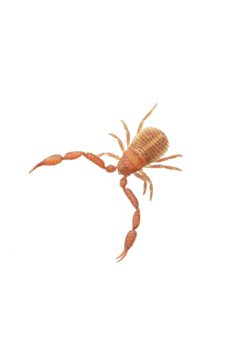
Small arachnids with flattened, oval bodies typically 2–5 mm in length. Lacks the elongated tail and stinger of true scorpions. Possesses large, pincer-like with movable and fixed fingers used for grasping prey. Body divided into prosoma () and opisthosoma (). Eight legs present; no or silk-producing structures. Coloration generally reddish-brown to dark brown.
Habitat
Predominantly subcortical, inhabiting spaces beneath the bark of dead and decaying trees. Also found in leaf litter, soil, moss, and rocky crevices. Some occupy specialized microhabitats including mammal nests and caves. Strongly associated with forested environments where woody debris accumulates.
Distribution
distribution with records from North America, Europe, Asia, and South America. Specific documented localities include Denmark, Norway, Sweden, and Parque Nacional Natural Serranía de Chiribiquete in Colombia. Individual ranges vary; many are geographically restricted while others are widespread.
Diet
Predatory, feeding on small arthropods and other microinvertebrates found in subcortical . Prey includes mites, springtails, small insects, and other soft-bodied . Uses to capture and manipulate prey.
Life Cycle
Development includes , , deutonymph, tritonymph, and stages. Nymphs resemble adults but are smaller and lack fully developed genital structures. Molting occurs between each nymphal stage. Females carry eggs in a attached to the underside of the . time varies by and environmental conditions.
Behavior
Well-documented phoretic : individuals attach to insects (primarily beetles in Cerambycidae, also Diptera and Hymenoptera) for to new patches. During , the pseudoscorpion ceases feeding and development. Attachment sites include legs, , and body surfaces of insects. Some exhibit male-male competition for optimal attachment positions on host beetles.
Ecological Role
in subcortical microarthropod , regulating of mites and other small . Serve as prey for larger arthropods. Phoretic associations with wood-boring beetles facilitate of ephemeral dead wood , contributing to nutrient cycling in forest .
Human Relevance
No direct economic importance. Occasionally encountered by entomologists and foresters when examining dead wood. Presence in collections may indicate previously overlooked phoretic associations. Some may inhabit human structures in forested areas but are harmless and non-venomous to humans.
Similar Taxa
- CheliferidaeAnother large of pseudoscorpions; distinguished by trichobothrial arrangement, body proportions, and chelal patterns.
- WithiidaeSimilar subcortical preferences; differs in structure and tarsal sensory organ .
More Details
Phoretic Associations
in Chernetidae has been specifically documented in Cordylochernes scorpioides, which rides beneath the of the giant harlequin (Acrocinus longimanus). Males of this defend abdominal attachment sites to intercept dispersing females, suggesting complex behavioral evolution beyond simple .
Taxonomic Scale
With 119 accepted and over 650 , Chernetidae represents one of the most species-rich within Pseudoscorpiones, reflecting substantial morphological and ecological diversification.