
Bothriocyrtum californicum
(O. Pickard-Cambridge, 1874)
California trapdoor spider, California cork-lid trapdoor spider
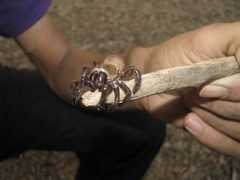
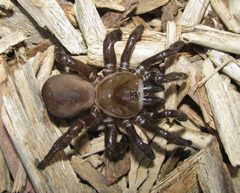
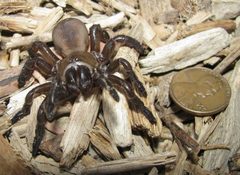
Bothriocyrtum californicum is a cork-lid trapdoor spider to arid regions of the southwestern United States and northwestern Mexico. This mygalomorph spider constructs burrows with a hinged, cork-like door made of soil and silk, which it uses to ambush passing prey. Males are smaller than females, a reversal of typical in spiders. The is notable as the first representative of its and to have its mitochondrial sequenced.
Pronunciation
How to pronounce Bothriocyrtum californicum: /ˌbɒθrioʊˈsɪrtəm ˌkæləˈfɔrnɪkəm/
These audio files are automatically generated. While they are not always 100% accurate, they are a good starting point.
Identification
Distinguished from other trapdoor spiders by its cork-lid burrow architecture, where the door fits flush with the ground surface like a cork in a bottle. The door is constructed from soil, vegetation, and silk. is reversed: males are smaller than females, unlike most spiders where males are larger or equal in size. As a mygalomorph, it has fangs that move parallel to each other rather than oppositely.
Images
Habitat
Shrublands and deserts of Southern California; occupies well-drained soils suitable for burrow construction.
Distribution
United States (California, Arizona); Mexico (northern Baja California Norte).
Host Associations
- Psorthaspis planata - Spider wasp that uses B. californicum as a for larval development
- Mephitis mephitis - Skunks dig up burrows to prey on spiders
Behavior
Constructs and maintains a burrow with a hinged trapdoor; remains concealed beneath the door to ambush prey.
Similar Taxa
- Promyrmekiaphila spp.Both are California trapdoor spiders in the Euctenizidae (formerly grouped with Halonoproctidae); Promyrmekiaphila constructs wafer-type doors rather than cork-lid doors
- Aptostichus spp.California trapdoor spiders in the Euctenizidae; distinguished by different burrow architecture and male secondary sexual characteristics
Sources and further reading
- BugGuide
- Wikipedia
- GBIF taxonomy match
- iNaturalist taxon
- NCBI Taxonomy
- Catalogue of Life
- Exciting News from Jason Bond Lab About Trapdoor Spiders | Bug Squad
- Congrats to Jason Bond, Executive Associate Dean, UC Davis College of Agricultural and Environmental Sciences | Bug Squad
- Bug Eric: Wasp Wednesday: Blue Mud Dauber, Chalybion californicum
- Tents in the Mojave: Western tent caterpillar, Malacosoma californicum — Bug of the Week
- Bug Eric: Wasp Wednesday: Trypoxylon
- Bug Eric: Wasp Wednesday: Chlorion aerarium
- The mitochondrial genome of Bothriocyrtum californicum (O. Pickard-Cambridge, 1874) (Araneae, Halonoproctidae) from ultraconserved elements (UCEs).