
Cyclocosmia
Ausserer, 1871
cork-lid trapdoor spider, Oreo spider (misnomer)
Species Guides
2- Cyclocosmia torreya(Torreya Trapdoor Spider)
- Cyclocosmia truncata(Ravine Trapdoor Spider)
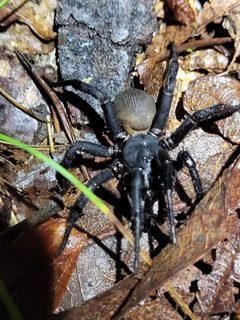
Cyclocosmia is a of mygalomorph trapdoor spiders in the Halonoproctidae, comprising thirteen distributed across North America (USA, Mexico) and Southeast Asia (China, Thailand, Vietnam, Laos). These spiders are distinguished by their unique abdominal : an abruptly truncated, hardened disc strengthened by ribs and grooves, used to seal burrow entrances when threatened. The genus was first described by Anton Ausserer in 1871 and serves as the type genus for Halonoproctidae. Species are long-lived, slow-maturing, and have demanding requirements that make them rare in collections despite local abundance.
Pronunciation
How to pronounce Cyclocosmia: //ˌsaɪkloʊˈkoʊzmiə//
These audio files are automatically generated. While they are not always 100% accurate, they are a good starting point.
Identification
The combination of mygalomorph spider with a truncated, disc-bearing is diagnostic for the . The abdominal disc with its system of ribs, grooves, and marginal spines distinguishes Cyclocosmia from all other trapdoor spiders. -level identification requires examination of disc pattern, hair count on the disc seam, and spermathecal shape in females or embolic structure in males. The cork-lid appearance of the disc when the spider seals its burrow is a field characteristic, though finding exposed specimens is uncommon.
Images
Habitat
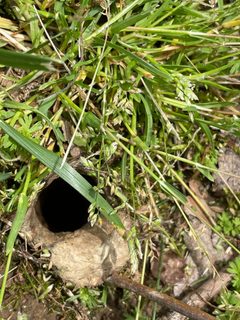
Mountainous regions with specific soil conditions suitable for burrow construction. Burrows consist of a wide vestibule and narrow basal tube, silk-lined only at the bottom, with well-camouflaged trapdoor. C. ricketti found at elevations of 980–1083 m in China. Burrow depth ranges 7–15 cm. requirements are demanding; the well-camouflaged trapdoors and specific microhabitat needs contribute to rarity in collections despite potential local abundance.
Distribution
Disjunct distribution across two regions: (1) Gulf of Mexico coast of southern United States (Alabama, Florida) and Mexico; (2) Southeast Asia including southern China (Fujian, Guangxi, Hunan, Jiangxi, Sichuan, Zhejiang provinces), Thailand, Vietnam, and Laos. Specific localities include Jinxiu County (Guangxi, China) at 980 m elevation and Mangdang Mountain (Fujian, China) at 1078–1083 m.
Diet
Venomous of small including grasshoppers and crickets.
Life Cycle
Exceptionally long-lived, with lifespans exceeding 12 years. Maturation requires at least 5 years. is not ; females can produce more than 300 spiderlings in a single reproductive event. potentially takes a full year. The characteristic opisthosomal disc develops by the second instar in C. ruyi; wild-caught spiderlings with fully developed discs are considered at least third instar.
Behavior
Constructs and maintains trapdoor burrows with camouflaged entrances. When disturbed, retreats to the lower portion of the burrow and uses the abdominal disc as a false bottom () to seal the entrance against such as . Defensive plugging of the burrow is the primary behavioral defense. Not aggressive toward humans; bites only occur upon significant provocation or handling.
Ecological Role
of small ground-dwelling . Burrowing activity may contribute to soil aeration and structure.
Human Relevance
Subject of viral misinformation in 2021 when images were falsely circulated depicting a 'deadly' beach-dwelling spider that could kill humans within five minutes. Arachnologists confirmed the has no known to humans, bites are rare and occur only upon handling, and these spiders are not beach-dwelling. The misinformation led to the nickname 'Oreo spider' due to the disc's resemblance to the cookie. Of scientific interest due to unique morphological adaptations and traits.
Similar Taxa
- Other Halonoproctidae generaShare mygalomorph trapdoor spider habits and characteristics but lack the diagnostic truncated abdominal disc with rib-groove system.
- Ctenizidae (sensu stricto)Formerly classified together; separated in 2018 revision. Similar trapdoor construction but distinct abdominal .
- IdiopidaeAustralian and African trapdoor spiders with convergent burrow-sealing but different abdominal structure.
Misconceptions
Widely circulated false claim that these spiders are deadly to humans, beach-dwelling, and cause death within five minutes of a 'sting' (spiders bite, not sting). These claims originated from a 2021 viral Facebook post using misappropriated photographs. The has no documented medical significance to humans.
More Details
Taxonomic history
Originally described in Ctenizidae; transferred to Halonoproctidae as type in 2018 revision based on molecular and morphological data.
Etymology
From Greek 'kyklos' (circle) and 'kosmeo' (to adorn), referring to the circular abdominal disc.
Research significance
Exceptional longevity and slow make this valuable for studying mygalomorph spider and conservation; demanding requirements suggest vulnerability to environmental disturbance.
Sources and further reading
- BugGuide
- Wikipedia
- GBIF taxonomy match
- iNaturalist taxon
- NCBI Taxonomy
- Catalogue of Life
- Oh, Those Beach-Bum Spiders! | Bug Squad
- A new trapdoor spider of Cyclocosmia Ausserer, 1871 from southern China (Araneae, Halonoproctidae).
- First description of the male of Cyclocosmiaricketti (Araneae, Halonoproctidae) from China.