
Bothriocyrtum
Simon, 1891
California trap-door spiders
Species Guides
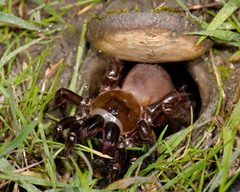
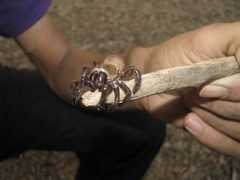
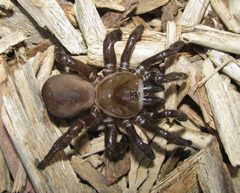
1- Bothriocyrtum californicum(California trapdoor spider)
Bothriocyrtum is a of mygalomorph spiders in the Halonoproctidae, established by Eugène Simon in 1891. The genus comprises three recognized native to North America and Taiwan. These spiders are commonly known as trap-door spiders, constructing burrows with hinged silk-lidded doors. The genus was separated from Cyrtocarenum based on distinct morphological features including arrangement and width of separation between certain structures.
Pronunciation
How to pronounce Bothriocyrtum: /ˌbɒθri.oʊˈsɪrtəm/
These audio files are automatically generated. While they are not always 100% accurate, they are a good starting point.
Identification
Distinguished from the related Cyrtocarenum by increased width of separation and a distinctly different arrangement of the . As mygalomorph spiders, members possess parallel fangs that move vertically. Specific diagnostic features for the genus require examination of genitalic and other morphological characters.
Images
Habitat
Shrublands and desert environments. B. californicum has been documented from shrublands and deserts of Southern California.
Distribution
Native to Mexico, Taiwan, and the southern United States. B. californicum occurs in Southern California, Arizona, and northern Baja California Norte, Mexico.
Behavior
Constructs silk-hinged trap doors at burrow entrances, a characteristic of trap-door spiders.
Similar Taxa
- CyrtocarenumHistorically congeneric; separated based on arrangement and width of separation
- CalisogaRelated mygalomorph with which B. californicum shares phylogenetic affinity
- PhyxioschemaRelated mygalomorph sharing phylogenetic placement with Bothriocyrtum
More Details
Species composition
Contains three as of April 2019: B. californicum (O. Pickard-Cambridge, 1874), B. fabrile, and B. tractabile.
Taxonomic history
Originally described by Simon in 1891 upon separation from Cyrtocarenum. placement has varied; NCBI historically placed it in Ctenizidae, but current accepted classification places it in Halonoproctidae.
Genomic resources
The complete mitochondrial of B. californicum was sequenced and annotated in 2025, representing the first mitogenome for the and Halonoproctidae. The genome is 14,081 with 69.2% AT-content.