
Euryopis
Menge, 1868
Ant-eating Spiders
Species Guides
8- Euryopis argentea(Silver Cobweb Weaver)
- Euryopis californica
- Euryopis formosa
- Euryopis funebris
- Euryopis mulaiki
- Euryopis quinquemaculata(Five-spotted ant-hunting spider)
- Euryopis tavara
- Euryopis texana
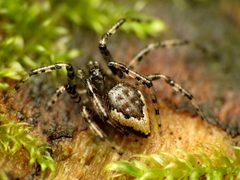
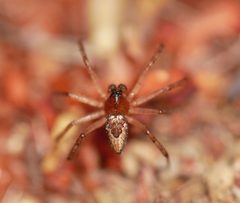
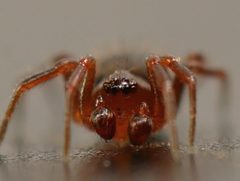
Euryopis is a of small comb-footed spiders ( Theridiidae, Hadrotarsinae) distributed worldwide. Unlike most theridiids, these spiders do not construct prey-catching webs. They are specialized , using a unique hunting technique where they immobilize ants with silk and haul them to safe feeding locations. The genus contains approximately 82 as of October 2025, with about 20 species recorded in North America north of Mexico.
Pronunciation
How to pronounce Euryopis: //juˈɹaɪəpɪs//
These audio files are automatically generated. While they are not always 100% accurate, they are a good starting point.
Identification
Distinguished from other Theridiidae by the combination of: high nearly as wide as long; exceptionally long, flat fangs; sub-triangular with bold patterning; and absence of prey-capturing web construction. Distinguished from the related Emertonella by male palpal cymbium structure (Emertonella has a prolateral- cymbial projection and retrolateral paracymbium). Distinguished from Phycosoma by cheliceral (Phycosoma has two promarginal teeth). Small size (under 5 mm) and cryptic ground-dwelling or foliage-perching habits also aid recognition.
Images
Habitat
Found on the ground, on foliage, or on tree trunks. Often associated with mounds and areas of high ant traffic. Occurs in varied environments from low elevations (70 m) to montane areas (up to 9,000 ft / ~2,700 m in Colorado).
Distribution
Worldwide distribution. North America: approximately 20 recorded north of Mexico, documented from Colorado, New Mexico, California, New York, and other regions. GBIF records indicate presence in Denmark, Norway, and Sweden. Chinese records exist for several species, though taxonomic revisions have transferred some former Chinese "Euryopis" species to Emertonella and Phycosoma.
Diet
Specialized of ants. Euryopis californica has been documented preying on Veromessor pergandei harvester ants. At least one feeds almost exclusively on harvester ants (Pogonomyrmex), which are among the most aggressive North American ants.
Life Cycle
Females produce white, hemispherical sacs covered in tufts of silk. Egg sac size is notably large relative to the small body size of the female.
Behavior
Hunts by ambush: sits with legs outstretched on substrate, waiting for ants to brush against them. Upon contact, rapidly circles the while flinging silk from to bond the ant to the surface. Once immobilized, bites the ant (typically on a leg joint), waits for venom to take effect, then constructs a silk "sling" to haul the prey to a secure feeding location. Does not construct prey-catching webs.
Ecological Role
of ants, including aggressive . Represents a specialized predator-prey interaction in -dominated .
Human Relevance
Not medically significant due to small size. Occasionally encountered indoors. Of interest to arachnologists and entomologists studying specialized -prey relationships.
Similar Taxa
- EmertonellaFormerly confused with Euryopis; distinguished by male palpal cymbium with prolateral- projection and retrolateral paracymbium. Approximately 30 transferred from Euryopis to Emertonella in recent taxonomic revisions.
- PhycosomaFormerly included now transferred to this ; distinguished by having two promarginal cheliceral teeth and different genitalia structure.
- DipoenaSome former Euryopis transferred here; distinguished by different abdominal and genitalic .
- StemmopsFormer Euryopis transferred here; distinct morphological features in arrangement and genitalia.
More Details
Taxonomic Instability
The has undergone significant taxonomic revision. Multiple have been transferred to other genera (Emertonella, Phycosoma, Dipoena, Stemmops, Coscinida, Eurypoena), and several former Euryopis species are now considered nomina dubia. Current Euryopis sensu stricto is narrower than historical usage.
Web Architecture
Unlike the tangled cobwebs typical of most Theridiidae, Euryopis does not construct prey-catching webs. Silk is used exclusively for prey immobilization, prey transport (the "sling"), and sac construction.
Sources and further reading
- BugGuide
- Wikipedia
- GBIF taxonomy match
- iNaturalist taxon
- NCBI Taxonomy
- Catalogue of Life
- Bug Eric: Ant-hunting spider, Euryopis
- Notes on hunting behavior of the spiderEuryopis californicaBanks, 1904 (Araneae: Theridiidae), a novel predator ofVeromessor pergandei(Mayr, 1886) harvester ants (Hymenoptera: Formicidae)
- Re-delimitation of the genus Emertonella (Araneae, Theridiidae, Hadrotarsinae) and taxonomic notes on Euryopis and Phycosoma from China.