
Euryopis funebris
(Hentz, 1850)
Euryopis funebris is a small cobweb spider in the Theridiidae, Hadrotarsinae. It is native to North America and has been introduced to South Africa. Unlike typical theridiids that build tangled webs, this is an active -hunting that uses silk to immobilize prey rather than construct capture webs.
Pronunciation
How to pronounce Euryopis funebris: /ˌjʊər.iˈoʊ.pɪs fjuːˈneɪ.brɪs/
These audio files are automatically generated. While they are not always 100% accurate, they are a good starting point.
Identification
Distinguished from other Theridiidae by the combination of: high nearly as wide as long; long, flat fangs; sub-triangular with bold pattern; absence of prey-capture web; and ground-dwelling habit. Differs from web-building theridiids like Latrodectus and Steatoda by its active hunting and lack of tangled webs. Separated from other Euryopis by specific genitalic characters and subtle pattern differences.
Images
Appearance
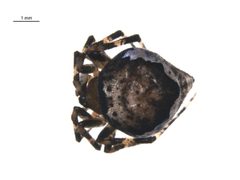
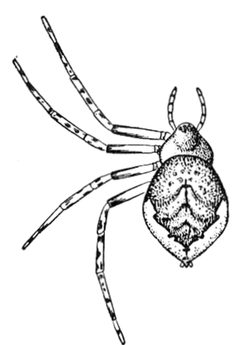
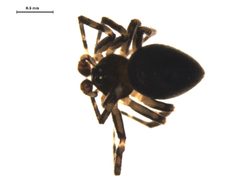
Very small spider with body length ranging 1.3–4.7 mm; females slightly larger than males. high, nearly as wide as long. sub-triangular in shape with bold color pattern. Long, flat fangs. Legs relatively short. Overall cryptic appearance when on natural substrates.
Habitat
Ground-dwelling spider found in diverse terrestrial . In North America, occurs at elevations of 8,500–9,000 feet in montane areas. In South Africa, recorded from Fynbos, Grassland, Indian Ocean Coastal Belt, Savanna, and Thicket biomes at altitudes from 1 to 1,444 m above sea level. Associated with colonies and areas of high ant traffic.
Distribution
Native to North America: Canada (British Columbia, Manitoba) and USA. Introduced to South Africa, where established in Eastern Cape, Gauteng, KwaZulu-Natal, Limpopo, Mpumalanga, Northern Cape, and Western Cape provinces. Notable South African locations include Addo Elephant National Park, iSimangaliso Wetland Park, and Kogelberg Nature Reserve.
Seasonality
Activity period not specifically documented for this . General spider activity in temperate regions typically spans spring through autumn.
Diet
Specialized . Hunts ants using ambush tactics: waits with legs outstretched until ant brushes against it, then rapidly circles prey while flinging silk to bond ant to substrate. Bites immobilized ant, usually on leg joint, then constructs silk sling to haul victim to secluded feeding location. At least one congeneric feeds almost exclusively on harvester ants (Pogonomyrmex).
Host Associations
- Ants - preyPrimary food source; specialized -hunting
Life Cycle
Females produce white, hemispherical sacs covered in silk tufts. Development includes egg, spiderling, and stages. Detailed duration unknown. stage not documented.
Behavior
Active hunter that does not build prey-capture webs. Uses silk defensively and offensively to immobilize prey rather than for web construction. Exhibits rapid circling when attacking ants, simultaneously wrapping them in silk. Constructs transport sling to move secured prey to feeding . -avoidance behavior includes feeding away from ant trails to prevent disturbance by other ants.
Ecological Role
regulating . Ground-dwelling habit places it in detrital . Likely prey for larger arthropods and small vertebrates. Ecological role in South African introduced range under study; listed as Least Concern by South African National Biodiversity Institute due to wide distribution.
Human Relevance
No documented medical or economic significance. Too small to be conspicuous to most observers. Presence indicates healthy and undisturbed ground . In South Africa, conservation status assessed due to introduced range establishment.
Similar Taxa
- Other Theridiidae (web-building genera)Euryopis lacks tangled prey-capture webs and shows active ground hunting versus sit-and-wait web-based
- Other Euryopis speciesRequires examination of genitalic characters and subtle pattern differences for definitive identification
More Details
Taxonomic placement
Placed in Hadrotarsinae based on structure, fang , female genitalia, and absence of prey-capture webs—characters that distinguish it from typical Theridiinae cobweb spiders.
Detection tips
Easily overlooked due to diminutive size and cryptic coloration. Best sought around mounds and areas of high ant activity. Pitfall trapping effective for sampling.
Sources and further reading
- BugGuide
- Wikipedia
- GBIF taxonomy match
- NCBI Taxonomy
- Catalogue of Life
- Meloidae Holdings | Entomology Research Museum
- Behold: the Banded Alder Borer | Bug Squad
- What's That Bug? | Bug Squad
- Bug Eric: Ant-hunting spider, Euryopis
- Look but do not touch: Blister beetles, Epicauta pensylvanica and E. funebris — Bug of the Week
- Uncategorized | Blog - Part 29