
Euryopis argentea
Emerton, 1882
Silver Cobweb Weaver
Euryopis argentea is a small cobweb spider in the Theridiidae, first described by Emerton in 1882. It belongs to the Hadrotarsinae, a group distinguished by their unique hunting . Unlike typical theridiids that construct tangled prey-catching webs, Euryopis are active that use silk in a specialized ambush technique. The species has been recorded from the United States, Canada, and Russia (Kamchatka).
Pronunciation
How to pronounce Euryopis argentea: /ˌjʊə.ɹiˈoʊ.pɪs ɑːrˈdʒɛn.ti.ə/
These audio files are automatically generated. While they are not always 100% accurate, they are a good starting point.
Identification
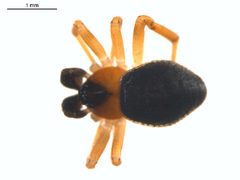
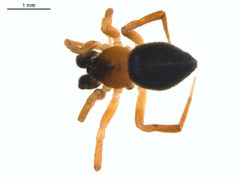
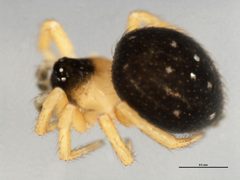
The sub-triangular shape and bold color pattern distinguish Euryopis from most other small theridiids. The combination of small size, high nearly as wide as long, and absence of a prey-catching web helps separate it from web-building Theridiidae. Within the , -level identification requires examination of genitalia; E. argentea specifically is documented from western North America and Kamchatka.
Images
Appearance
Small spider with body length ranging 1.3–4.7 mm, females slightly larger than males. has a distinctive sub-triangular shape with bold color pattern. is high and nearly as wide as long. Possesses exceptionally long, flat fangs. Overall appearance is cryptic when positioned on natural substrates.
Habitat
Found in montane and upper elevation , including areas around 8,500–9,000 feet elevation in the Rocky Mountains. Occurs on ground, foliage, and tree trunks, particularly in locations with high activity such as near ant mounds and along ant foraging trails.
Distribution
United States (western states including Colorado, Nevada, California), Canada, and Russia (Kamchatka). Records in North America are primarily from west of the Continental Divide.
Diet
Specialized of ants. Uses a unique hunting technique: waits in ambush with legs outstretched, then upon contact with an , rapidly circles the prey while flinging silk to bond it to the substrate. Bites the ant, usually on a leg joint, then creates a silk 'sling' to transport the immobilized prey to a secluded feeding location.
Life Cycle
Female produces a white, hemispherical sac covered in small tufts of silk. The sac is surprisingly large relative to the female's body size. Developmental stages follow typical spider pattern of egg, spiderling, and .
Behavior
Does not construct prey-catching webs. Hunting is entirely ambush-based, relying on rapid silk deployment rather than web entanglement. Has been observed to prey on aggressive including harvester ants (Pogonomyrmex). The silk-sling for transporting prey is distinctive and documented in the .
Ecological Role
Specialized that may help regulate ant in montane . Its unique hunting strategy represents a distinct among spiders, filling a predatory role that few other arthropods exploit due to the defensive capabilities of ants.
Human Relevance
No documented economic or medical importance. Too small to be conspicuous to most observers; occasionally encountered by arachnologists and naturalists in field surveys.
Similar Taxa
- Other Theridiidae (typical cobweb spiders)Most theridiids construct tangled, three-dimensional webs for prey capture; Euryopis lacks these webs and hunts actively on the ground or vegetation.
- Other Euryopis speciesApproximately 20 occur in North America north of Mexico; most share the sub-triangular and -hunting , requiring genital examination for definitive identification.
- Ant-mimicking spiders (e.g., some Salticidae, Corinnidae)Some spiders resemble ants in appearance and , but Euryopis does not mimic ants—it preys on them, and has a very different body form with the distinctive high, broad .
More Details
Taxonomic placement
Placement in Hadrotarsinae is based on morphological characters including the high , long flat fangs, female genital anatomy, and the absence of prey-catching webs.
Hunting specialization
The -hunting of Euryopis represents a derived within Theridiidae, a otherwise characterized by web-building. At least one Euryopis feeds almost exclusively on harvester ants (Pogonomyrmex), which possess stingers and are among the most aggressive North American ants.