
Euryopis formosa
Banks, 1908
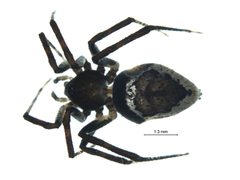
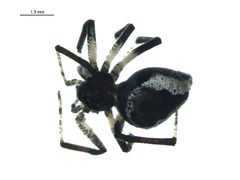
Euryopis formosa is a of cobweb spider in the Theridiidae, first described by Banks in 1908. It belongs to the Euryopis, a group of small -hunting spiders that exhibit unusual behavioral traits for their family. The species is found in the United States and Canada. Like other members of its genus, it does not construct prey-catching webs but instead employs active hunting strategies targeting ants.
Pronunciation
How to pronounce Euryopis formosa: /ˌjʊr.iˈoʊ.pɪs fɔrˈmoʊ.sə/
These audio files are automatically generated. While they are not always 100% accurate, they are a good starting point.
Identification
Identification to level requires examination of genitalic characters. Distinguished from other Theridiidae by the combination of: high , long flat fangs, absence of prey-catching web construction, and - hunting . Distinguished from other Euryopis species by subtle morphological differences in genitalia and potentially geographic range; precise field identification to species is challenging without microscopic examination.
Images
Appearance
Small spider with body length ranging from approximately 1.3–4.7 mm. Possesses a high nearly as wide as long, exceptionally long and flat fangs, and a sub-triangular with bold color pattern. The abdomen typically displays distinctive markings that may aid in camouflage against substrates.
Habitat
Found in varied terrestrial including ground surfaces, foliage, and tree trunks. Associated with areas of high activity, particularly near ant mounds and ant traffic corridors. The Colorado specimen was collected at 8,500–9,000 feet elevation in upper watershed reaches, suggesting for montane environments.
Distribution
United States and Canada. Specific state/province records not comprehensively documented; present in North America.
Diet
Ants. Like other Euryopis , has been observed to prey on ants using specialized hunting techniques. One congeneric species feeds almost exclusively on harvester ants (Pogonomyrmex), suggesting similar specialization may occur in E. formosa.
Life Cycle
Females produce white, hemispherical sacs covered in tufts of silk. Egg sac size is notably large relative to maternal body size. Developmental details specific to this are not documented.
Behavior
Does not spin prey-catching webs. Employs ambush hunting: sits with legs outstretched on substrate, waits for contact, then rapidly circles the ant while flinging silk to bond it to the substrate. Once immobilized, bites the ant (typically at leg joint) and waits for venom to take effect. Uses silk "sling" to transport prey to undisturbed feeding location. Exhibits cryptic, immobile posture when not hunting.
Ecological Role
of ants, filling a few other predators exploit due to defensive capabilities. Potential of ant colonies, particularly harvester ants where such associations occur.
Similar Taxa
- Other Euryopis speciesShare -level traits of small size, -hunting , and sub-triangular ; require genitalic examination for definitive separation
- Other TheridiidaeDistinguished by absence of prey-catching web construction and active -hunting ; most theridiids construct tangled cobwebs for prey capture
More Details
Taxonomic Placement
Placed in Hadrotarsinae based on shared morphological characters including high , long flat fangs, female genitalia anatomy, and absence of prey-catching webs.
Conservation Status
Not formally assessed; likely overlooked due to small size and cryptic rather than rarity.
Sources and further reading
- BugGuide
- Wikipedia
- GBIF taxonomy match
- NCBI Taxonomy
- Catalogue of Life
- Bug Eric: Ant-hunting spider, Euryopis
- Cicindela formosa pigmentosignata (the “reddish-green sand tiger beetle”) | Beetles In The Bush
- Cicindela lengi vs. Cicindela formosa | Beetles In The Bush
- A Termite-Control Twofer: How Baiting One Colony of Formosan Subterranean Termites Can Knock Out the Colony Next Door