
Euryopis quinquemaculata
Banks, 1900
Five-spotted ant-hunting spider
Euryopis quinquemaculata is a small cobweb spider in the Theridiidae, placed in the Hadrotarsinae. Unlike typical theridiids that construct tangled webs to catch prey, this is an active that hunts without building prey-capturing webs. The species name refers to the five-spotted abdominal pattern characteristic of this and related Euryopis species. It occurs in the United States, where it inhabits areas with high ant activity.
Pronunciation
How to pronounce Euryopis quinquemaculata: //juːˈraɪəpɪs kwɪŋkwɪˌmækjʊˈleɪtə//
These audio files are automatically generated. While they are not always 100% accurate, they are a good starting point.
Identification
Distinguished from other Theridiidae by the combination of: high, nearly square ; exceptionally long, flat fangs; sub-triangular with bold spotted pattern; absence of prey-capturing web. Separated from other Euryopis by specific details of abdominal pattern (five spots) and genitalic characters. Differs from typical cobweb spiders (e.g., Latrodectus, Steatoda) in its active hunting and lack of web construction for prey capture.
Images
Appearance
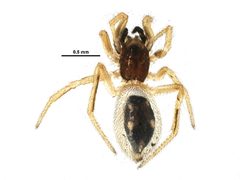
Very small spider with body length 1.3–4.7 mm; females larger than males. High nearly as wide as long. Exceptionally long, flat fangs. with distinctive sub-triangular shape and bold color pattern, typically with five spots. Overall cryptic appearance when on natural surfaces.
Habitat
Found on ground, foliage, or tree trunks in areas with high traffic. Often associated with ant mounds and places where ant activity is concentrated. Occurs in various terrestrial including open woodlands and grasslands with abundant ant .
Distribution
United States. Records from multiple states across the country. North America, present.
Diet
Specialized of ants. At least one related feeds almost exclusively on harvester ants (Pogonomyrmex), which are among the most aggressive North American ants equipped with stingers. The spider's ability to subdue dangerous prey demonstrates specialized hunting adaptations.
Life Cycle
Female produces white, hemispherical sac covered in tufts of silk. Egg sac size is notably large relative to the small body size of the female. Developmental details otherwise poorly documented.
Behavior
Unique hunting technique: sits with legs outstretched in ambush posture, waiting for to brush against it. Upon contact, rapidly runs around the ant while flinging silk from , bonding the ant to the substrate before the insect can respond. Once immobilized, bites the ant (usually on a leg joint) and waits for venom to take effect. Then fashions a silk 'sling' to haul the victim to a secluded feeding location away from other ants. Does not construct prey-catching webs, departing radically from typical theridiid .
Ecological Role
Specialized that occupies a distinctive . Acts as control on ant colonies, particularly harvester ants. Few predators target ants due to their aggressive defenses; Euryopis represents an important exception in predator-prey dynamics.
Human Relevance
No documented negative impacts. Too small to bite humans effectively. Not a pest . Generally overlooked due to diminutive size and cryptic habits. May be encountered during field observations near mounds.
Similar Taxa
- Other Euryopis speciesShare sub-triangular and -hunting , but distinguished by specific spot patterns and genitalic ; E. quinquemaculata specifically has five spots
- Typical Theridiidae (e.g., Latrodectus, Steatoda)Construct tangled prey-capturing webs and have rounded ; Euryopis lacks prey-catching webs and has flattened, sub-triangular abdomen with active hunting
More Details
Taxonomic placement
Placed in Hadrotarsinae based on shared morphological characters including high , long flat fangs, female genitalia anatomy, and absence of prey-catching webs
Research history
- documented by Porter and Eastmond (1981) for related Euryopis coki preying on Pogonomyrmex harvester ants; E. quinquemaculata presumed to share similar ecological specialization
Sources and further reading
- BugGuide
- Wikipedia
- GBIF taxonomy match
- NCBI Taxonomy
- Catalogue of Life
- California Dogface Butterfly Steals the Show | Bug Squad
- This Bug's for You--And That One, Too! | Bug Squad
- The Hornworms Are Not Your Friends | Bug Squad
- Insect FAQs | Entomology Research Museum
- Bug Eric: Ant-hunting spider, Euryopis
- Tough to be a hornworm: Tomato and tobacco hornworms, Manduca quinquemaculata and M. sexta — Bug of the Week