
Menemerus semilimbatus
(Hahn, 1829)
Half-edged Wall Jumping Spider
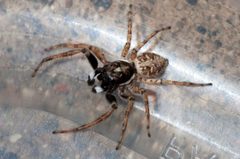
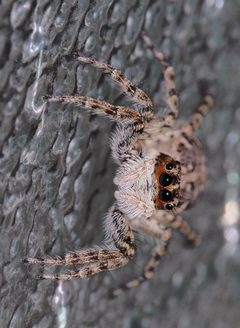
Menemerus semilimbatus is a medium-sized jumping spider in the Salticidae, commonly known as the Half-edged Wall Jumping Spider. It is characterized by its dorso-ventrally flattened body, grayish-white coloration with distinctive V-shaped markings on the , and preference for vertical surfaces. The is native to the Mediterranean region but has been introduced to parts of the Americas including Argentina, Chile, and the United States.

Pronunciation
How to pronounce Menemerus semilimbatus: //mɛˈnɛmərəs ˌsɛmɪlɪmˈbeɪtəs//
These audio files are automatically generated. While they are not always 100% accurate, they are a good starting point.
Identification
Distinguished from similar Menemerus bivittatus (Gray Wall Jumper) by specific abdominal pattern of V-shaped markings rather than reversed color patterns between sexes. Distinguished from Platycryptus undatus by native Mediterranean distribution versus native North American range of the latter, and by specific marking patterns. Identification to level requires examination of epigyne in females (notch at edge, two oval depressions in half) or structure in males.
Images
Appearance
Body length 6.5–8.4 mm, with males slightly smaller than females. Body dorso-ventrally flattened and covered with short, dense grayish-white hairs. with white band on side margins and small white triangular marking in center. dorsally yellowish to grayish with characteristic pattern of several bright V-shaped markings. Legs light brown with darker rings and patches. Palps hairy and whitish. large and forward-facing. Females possess notch at edge of epigyne and two oval depressions in half.
Habitat
; occurs in gardens and on interior and exterior walls of buildings. Typically found on vertical walls where it stalks prey.
Distribution
Native to Mediterranean region including Europe, southern Asia, Turkey, Caucasus, and Iran. Introduced and established in Argentina, Chile, Ecuador, and United States. Also recorded from Macaronesia (Canary Islands, Azores: Faial, São Miguel, Santa Maria).
Diet
Active that stalks prey on vertical surfaces. Specific prey items not documented in available sources.
Behavior
hunter that actively stalks prey on vertical walls rather than building webs to capture prey. habits allow close association with human structures.
Ecological Role
in urban and suburban ; contributes to control of small on building surfaces.
Human Relevance
Beneficial presence in human dwellings due to on small arthropods; no documented negative impacts. nature brings it into frequent contact with humans without aggressive reported.
Similar Taxa
- Menemerus bivittatusSimilar size and preference for vertical walls; distinguished by reversed color pattern between sexes rather than V-shaped abdominal markings, and by native Old World tropical distribution versus Mediterranean native range of M. semilimbatus
- Platycryptus undatusSimilar occurrence on vertical surfaces and comparable size; distinguished by native North American distribution, different marking patterns, and lack of Mediterranean origin
More Details
Taxonomic Note
originally described as Attus semilimbatus by Hahn in 1829; later transferred to Menemerus.
Introduction History
Introduced in the Americas represent human-mediated , with established populations in Argentina, Chile, Ecuador, and USA.