
Menemerus bivittatus
(Dufour, 1831)
gray wall jumper, gray wall jumping spider
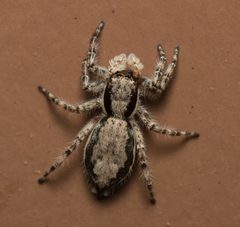
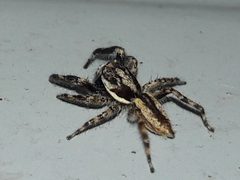
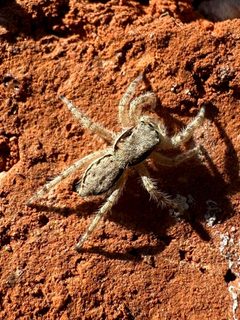
A pantropical jumping spider (Salticidae) commonly known as the gray wall jumper. are dorso-ventrally flattened with dense grayish-white hairs, approximately 9 mm in length. The is notable for its specialized 'snatching' predatory —stealing prey or from ants—and has been widely introduced across tropical and subtropical regions worldwide.
Pronunciation
How to pronounce Menemerus bivittatus: /mɛnəˈmɛrəs bɪvɪˈteɪtəs/
These audio files are automatically generated. While they are not always 100% accurate, they are a good starting point.
Identification
Dorso-ventrally flattened body covered with short dense grayish-white hairs. Tufts of dark brown bristles present near the large, forward-facing . Males approximately 9 mm, slightly smaller than females. Male: blackish longitudinal stripe with brownish-white stripe on either side of ; black and white and ; legs with transverse black and white bandings. Female: generally paler and more brown; larger carapace and abdomen; carapace edged with two black bands and thin white stripe; abdomen with broad black stripes on each side uniting at end; legs banded but paler than male. spiders resemble female.
Images
Habitat
Found on vertical surfaces including walls of buildings and tree trunks. Occupies pantropical and introduced subtropical environments. In urban settings, frequently observed on exterior walls of man-made structures.
Distribution
Native to Sub-Saharan Africa (Nigeria, Kenya, DR Congo, South Africa, Senegal, etc.). Widely introduced and now in tropical and subtropical regions. Present in North America (Florida, Texas, California), Central and South America (Paraguay, Colombia, Venezuela, Caribbean islands), southern Europe, Turkey, India, China, Taiwan, Japan, Australia, Pacific Islands, and Brazil.
Diet
Small flies that alight on walls; insects at least twice its own size including crane flies. Specialized 'snatching' documented: steals pupae and other material transported by ants of Camponotus crassus.
Life Cycle
Female builds eggsac in concealed positions such as cracks, laying 25–40 in a purse-like silken case. Guards eggs until hatching in approximately three weeks. Young spiders disperse after hatching.
Behavior
Active stalking that does not build capture webs. Uses highly coordinated jumping ability to capture prey and move between locations. Possesses high visual acuity with large capable of focusing on objects and detecting different colors. Male possesses stridulatory apparatus (bristles on palpal and ridges on ) used in by rubbing ridges against palpal teeth. In India, often vibrates hairy palps while . Observed loitering near entrances to nests in Gambia. Exhibits 'snatching' : steals prey or from ants.
Ecological Role
of small flying insects and . May exert pressure on colonies through loitering at nest entrances.
Human Relevance
Common inhabitant of urban and suburban environments due to association with building walls. No documented negative impacts; may provide minor pest control of small flies.
Sources and further reading
- BugGuide
- Wikipedia
- GBIF taxonomy match
- iNaturalist taxon
- NCBI Taxonomy
- Catalogue of Life
- Grasshoppers of Colorado
- Twostriped Grasshopper
- Grasshoppers of Colorado
- Grasshoppers of Colorado
- Grasshopper Links
- Grasshoppers of Colorado
- Comportamento Predatório Incomum de Menemerus bivittatus (Dufour) (Araneae, Salticidae)