
Plexippus paykulli
(Audouin, 1826)
Pantropical Jumping Spider
Plexippus paykulli is a jumping spider native to Southeast Asia, now established across tropical and subtropical regions worldwide. Commonly called the pantropical jumping spider, it is strongly associated with human-built structures, particularly building exteriors near light sources where it hunts insects. The exhibits pronounced : males display black bodies with bold white stripes, while females are brownish-grey with tan markings. It is an active that does not construct prey-capture webs, relying instead on acute vision, stalking, and jumping to subdue prey.
Pronunciation
How to pronounce Plexippus paykulli: //ˈplɛk.sɪ.pʊs paɪˈkʊl.i//
These audio files are automatically generated. While they are not always 100% accurate, they are a good starting point.
Identification
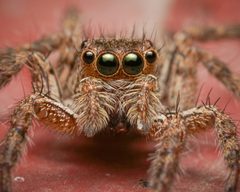
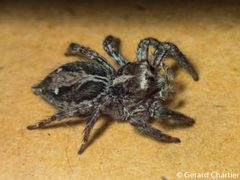
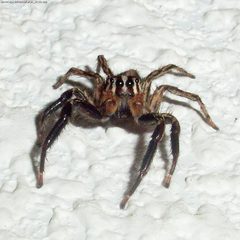
Males are readily identified by the black body with three prominent white stripes—one central on the and two lateral—continuing onto the to create a striped appearance. Females are distinguished from similar brownish jumping spiders by the broad tan stripe that extends from the onto the abdomen, where it breaks into two chevrons, plus paired white spots near the abdomen. The combination of building association, robust build, and specific striping patterns separates it from the Gray Wall Jumper (Menemerus bivittatus), which lacks the male's bold facial striping and shows different abdominal patterning.
Images
Habitat
Strongly associated with human-made structures, especially building exteriors, walls, and near artificial light sources. Also recorded from agricultural settings including citrus groves and cotton fields. In India, found in human habitations, agro-, gardens, cultivated fields, and semi-natural near river systems. Prefers elevated positions such as ceiling edges for retreat construction.
Distribution
Native to Southeast Asia; now in tropical and subtropical regions. Introduced and established in the Americas (southern United States to Paraguay), Australia (Queensland, Northern Territory, Torres Strait Islands), Pacific islands, Maldives, Africa, Middle East, Pakistan, India, Nepal, China, and Fiji. In the United States, resident year-round in South Carolina, Georgia, Florida, Gulf Coast states, and south Texas, with outlying in New Mexico and along the Atlantic seaboard likely from accidental introductions.
Seasonality
Active year-round in tropical and subtropical climates where established. In the United States, present year-round in southern states; activity patterns follow local temperature and prey availability rather than strict seasonality.
Diet
of insects and other spiders. Documented prey includes small , flies, flying ants, mosquitoes, , cotton jassids, sugarcane planthoppers, and other arthropods. Can subdue prey up to twice its body size through brute strength, often overpowering large prey before venom immobilizes them. Has been observed clinging to escaping prey until subdued.
Life Cycle
Females construct lens-shaped silken sacs approximately 3 cm in diameter containing 35–60 eggs, enclosed within a larger silken retreat (25–35 mm). Egg sacs are placed in concealed locations under floorboards, cracks, eaves, or under boards. Females guard eggs until spiderlings emerge and disperse 3–4 weeks later. Development includes stages resembling females in coloration.
Behavior
active hunter that does not spin prey-capture webs. Constructs dense, structurally complex silken retreats in elevated positions from which to launch hunting forays. Approaches prey stealthily with acute vision, then jumps up to 50 mm to capture. Modifies stalking based on prey mobility: greater stealth and shorter jump distance for mobile prey on camouflaged backgrounds to avoid detection. Males perform complex using foreleg waving, rhythmic movements, and colorful ; mating tactics vary with female maturity and location (visual displays away from nest, vibratory displays at nest, cohabitation with subadult females). Copulation often occurs suspended on the female's dragline with unusually short durations. Non-aggressive toward humans; curious rather than defensive.
Ecological Role
Significant agent regulating insect pest in agricultural and urban . Contributes to agro-ecosystem sustainability without ecological harm. Documented of agricultural pests including cotton jassids and sugarcane planthoppers, as well as household pests such as mosquitoes and . Venom proteins show bio- potential.
Human Relevance
Beneficial in urban and agricultural settings as natural pest control. Commonly encountered on building exteriors and near lights, where it reduces of nuisance insects. Non-aggressive and harmless to humans; bites are rare and not medically significant. Valued in programs for cotton and other crops.
Similar Taxa
- Menemerus bivittatus (Gray Wall Jumper)Similar size, preference for buildings, and general appearance; distinguished by less pronounced striping in males, different abdominal pattern in females, and lack of bold facial markings
More Details
Taxonomic etymology
Named in honor of Swedish entomologist Gustaf von Paykull (1757–1826)
Courtship versatility
Males employ three distinct mating tactics depending on female maturity and location: visual displays for mature females away from nests, vibratory displays for mature females in nests, and cohabitation with subadult females in nests
Prey capture mechanics
Large prey are often overpowered by brute strength before venom takes effect; spiders may ride on escaping prey until subdued
Sources and further reading
- BugGuide
- Wikipedia
- GBIF taxonomy match
- iNaturalist taxon
- NCBI Taxonomy
- Catalogue of Life
- Bug Eric: Pantropical Jumping Spider
- Royal wanderers settle into a far-away home: Monarch butterflies, Danaus plexippus — Bug of the Week
- A surprisingly early visit by a royal: Monarch butterflies and their caterpillars, Danaus plexippus — Bug of the Week
- Monarch Christmas, Danaus plexippus — Bug of the Week
- Orange and Black II: Milkweed leaf beetle, Labidomera clivicollis; Oleander aphid, Aphis nerii; Milkweed Bug, Oncopeltus fasciatus; Monarch, Danaus plexippus — Bug of the Week
- Monarchs ring in the New Year at home: Non-migratory Monarch butterflies, Danaus plexippus — Bug of the Week
- Display, mating, and predatory behaviour of the jumping spider Plexippus paykulli (Araneae: Salticidae)
- A preliminary investigation on the jumping spider Plexippus paykulli (Araneae: Salticidae) from Akola district, Maharashtra, India