
Habronattus klauseri
(G.W. Peckham & E.G. Peckham, 1901)
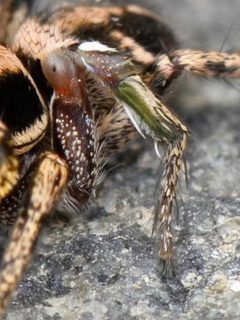
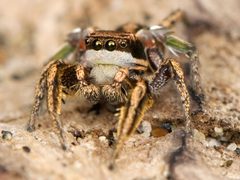
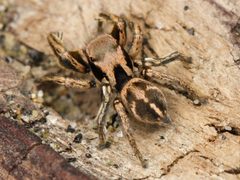
Habronattus klauseri is a of jumping spider in the Salticidae, described by Peckham & Peckham in 1901. The Habronattus contains approximately 100 species, with the greatest diversity in southwestern North America. Members of this genus are small, ground-dwelling spiders known for elaborate multimodal combining visual signals and acoustic vibrations. H. klauseri occurs in the western United States and Mexico.
Pronunciation
How to pronounce Habronattus klauseri: /hæbroʊˈnætəs ˈklaʊsɛri/
These audio files are automatically generated. While they are not always 100% accurate, they are a good starting point.
Identification
Habronattus are small jumping spiders, typically 3-5 mm in body length. Males of the often display coloration and possess modified third legs used in ; some species have prominent spurs on the 'knee' joint of the third leg. Females are generally more subdued in coloration. Definitive identification of H. klauseri specifically requires examination of diagnostic morphological features not detailed in general sources.
Images
Habitat
Ground-dwelling; found in areas of scattered vegetation including prairies, grasslands, and open with stones or leaf litter. Occurs from low elevations to high elevations in montane regions.
Distribution
Western United States and Mexico. Records indicate presence in Middle America and North America.
Behavior
Males perform complex combining visual signals (leg movements, display of colored leg segments) with acoustic signals (drumming or tapping vibrations transmitted through the substrate). This multimodal communication has been described as among the most elaborate of any terrestrial in the .
Ecological Role
Active ; hunting on foot using acute vision rather than building webs. Serves as a predator of small insects and potentially as prey for larger arthropods and vertebrates.
Similar Taxa
- Habronattus cuspidatusOccurs in overlapping range (Colorado); males possess conspicuous spur on third leg knee joint used in
- Habronattus calcaratusRelated with similar elaborate courtship and modified third legs
- Euophrys monadnockSimilar small size and ground-dwelling habit; males display bright orange leg segments in courtship, potentially causing initial confusion with male Habronattus
More Details
Taxonomic note
NCBI lists this as 'Habronattus klauserii' (with double 'i'), but the accepted spelling following Peckham & Peckham (1901) and GBIF is 'Habronattus klauseri'.
Genus-level traits
While specific details for H. klauseri are limited, the Habronattus has been intensively studied for courtship . Research by Elias et al. (2012) on the H. coecatus group documents complex 'orchestrated' multimodal signals combining visual and vibratory components.