
Habronattus coecatus
(Hentz, 1846)
Habronattus coecatus is a of jumping spider in the Salticidae. The species occurs across North America, Mexico, and Bermuda. Males possess distinctive red on the and exhibit elaborate multimodal courtship involving both visual displays and vibratory signals. The species belongs to a known for complex courtship that have been described as among the most elaborate of any terrestrial .
Pronunciation
How to pronounce Habronattus coecatus: //həˌbroʊˈnætəs siˈkɑːtəs//
These audio files are automatically generated. While they are not always 100% accurate, they are a good starting point.
Identification
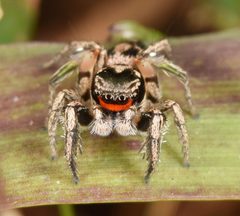
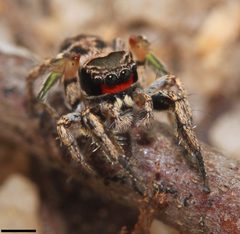
Males can be recognized by the red covering the , contrasting with the otherwise black and tan-scaled body. Females lack this red coloration. The may be distinguished from other Habronattus species by specific details of the male's and genitalic , though these require close examination.
Images
Appearance
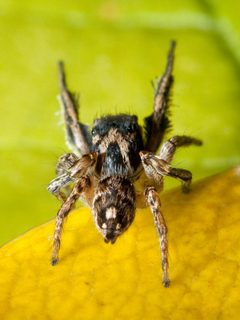
Mostly black body with bands of tan . Males have the covered with red scales.
Habitat
Ground-dwelling in areas of scattered vegetation, including prairie and open ground with stones or leaf litter. Found on vegetation close to the ground and on flowers where they hunt.
Distribution
Mexico, United States, Bermuda. Records also indicate presence in Pakistan and Caribbean region.
Diet
Active hunters of small arthropods. Has been observed stalking mining bees (Andrena spp.) on flowers.
Life Cycle
Typical salticid development: in silken sac, spiderlings disperse, gradual maturation through successive . Specific details for this are not documented in available sources.
Behavior
Males perform elaborate combining visual signals (leg positioning and movement) with vibratory drumming on the substrate. This multimodal communication is synchronized and complex. The hunts actively on foot rather than building webs, using acute vision to locate prey.
Ecological Role
of small insects and other arthropods. Serves as a model for predator mimicry in other insects; the Habronattus has been documented as a target of mimicry by bee flies (genus Epacmus) and other insects that evolve spider-like appearances to deter .
Human Relevance
Subject of scientific research on spider courtship and multimodal communication. Contributes to understanding of -prey dynamics and mimicry evolution in insects.
Similar Taxa
- Habronattus cuspidatusSimilar ground-dwelling Habronattus with elaborate male courtship, but males of H. cuspidatus possess a conspicuous spur on the third leg knee joint not described for H. coecatus.
- Euophrys monadnockAnother small colorful jumping spider found in similar , but males have bright orange on third and fourth legs and black hair brushes on front legs, lacking the red clypeal of H. coecatus males.
More Details
Courtship complexity
The Habronattus coecatus group has been studied for its exceptionally elaborate courtship, described in scientific literature as 'orchestrating the score' due to the precise synchronization of visual and vibratory signals.