
Euophrys monadnock
Emerton, 1891
Euophrys monadnock is a jumping spider in the Salticidae, first described by James Henry Emerton in 1891. It occurs across northern North America, including Canada and the northern United States, with records extending south along the Rocky Mountains to Colorado. Males are notably colorful with distinctive black and orange leg markings, while females are more subdued in coloration. The species inhabits ground-level environments in forested and shrubland .
Identification
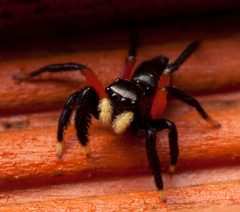
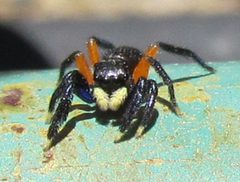
Males are unmistakable due to the unique combination of black body, bright orange on legs III and IV, and white . No other North American jumping spider shares this specific color pattern. Females may be more difficult to distinguish and require careful examination. The is smaller than many conspicuous Habronattus species with which it might be confused.
Images
Appearance
Small jumping spider, approximately 3–4 millimeters in body length. Males display striking with vivid coloration: black body with bright orange on the third and fourth pairs of legs, and white on the legs. The front legs bear thick brushes of black hair. Females are more cryptically colored and less conspicuous than males.
Habitat
Ground-dwelling in forested and shrubland . Found beneath Ponderosa Pines and in understory thickets of Gambel's Oak and other shrubs. Occurs at moderate to high elevations, including montane environments. Colorado records span elevations around 7,000 feet.
Distribution
Northern latitudes and high elevations of North America. Documented across Canada (Alberta, British Columbia) and northern United States. Southward distribution follows the Rocky Mountains, with records from Colorado including Roxborough State Park, Upper Maxwell Falls, Lump Gulch, and Westcliffe. Historical record from "West Cliff" (now Westcliffe), Colorado collected by Theodore Cockerell in the 1890s.
Seasonality
have been recorded from June through August in Colorado. Specific across the full range is not well documented.
Behavior
Males perform visual utilizing their contrasting leg colors. During display, males lift the front legs to show the black hair brushes, raise the third pair of legs to expose the orange , and orient the fourth pair to make the orange femora visible to females. As a salticid, the possesses acute vision used for hunting and communication. Individuals are active on the ground surface, hopping over grass and leaf litter.
Similar Taxa
- Habronattus speciesSimilar small size and ground-dwelling habit; males of both groups can be colorful. Euophrys monadnock males are distinguished by the specific pattern of orange on legs III and IV combined with white , which no Habronattus exhibits.
More Details
Taxonomic history
First described by James Henry Emerton in 1891. The specific epithet "monadnock" refers to an isolated rocky hill or knob rising from flatland, though the precise etymological connection to this spider is not documented in available sources.
Conservation of specimens
One observer who photographed a male in Colorado chose to release the specimen rather than retain it, citing the "utter uniqueness of this " despite the usual scientific preference for voucher specimens.