
Euophrys
C. L. Koch, 1834
Species Guides
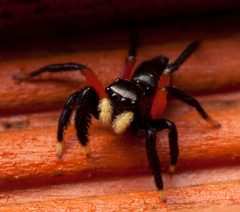
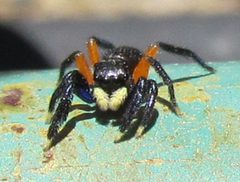
1Euophrys is a of jumping spiders ( Salticidae) first described by Carl Ludwig Koch in 1834. The genus contains approximately 99 distributed across Eurasia, Africa, and the Americas. Notable members include E. omnisuperstes, which inhabits Mount Everest at elevations up to 6,700 meters, and E. monadnock, a colorful North American species with distinctive male . Species in this genus exhibit typical salticid characteristics including excellent vision and complex visual communication.
Pronunciation
How to pronounce Euophrys: /euˈɒfrɪs/
These audio files are automatically generated. While they are not always 100% accurate, they are a good starting point.
Identification
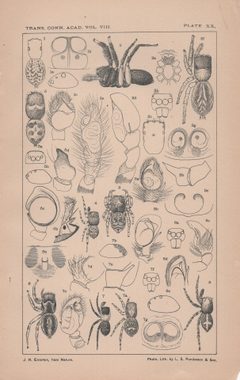
Members of Euophrys can be distinguished from similar salticid by a combination of morphological and behavioral traits. The genus is currently undergoing taxonomic revision; E. sutrix, for example, has been reclassified as a freyine rather than a euophryine. Males of some , such as E. monadnock, display striking with bright orange on the third and fourth pairs of legs and black hair brushes on the front legs. Accurate species identification often requires examination of genitalia and reference to specialized taxonomic literature.
Images
Habitat
vary widely by . E. omnisuperstes occupies rocky terrain at extreme high elevations on Mount Everest. E. monadnock occurs in montane habitats with Ponderosa Pine and Gambel Oak understory at elevations around 7,000 feet in the Rocky Mountains. Other species occupy diverse terrestrial environments across their broad geographic range.
Distribution
Eurasia, Africa, and the Americas. Specific records include: North America (Canada, United States including Colorado, California, North Dakota, Wisconsin, Ohio, Pennsylvania); South America (Argentina, where E. sutrix is known as "aranhas papa-moscas"); New Zealand (E. parvula); and extreme high elevations in the Himalaya (E. omnisuperstes).
Diet
E. omnisuperstes has been observed feeding on insects blown upwards by wind at high elevations. E. sutrix is a principal of fruit flies in peach orchards in southern Brazil. Other are presumed to be predators on small arthropods typical of jumping spiders.
Behavior
Males perform complex involving multichannel communication. In E. parvula, courtship is segregated into phases: visual displays at distance, followed by tactile or chemotactic signals (tapping, scraping, stroking) upon close approach. Males exhibit courtship versatility conditional on female location and maturity: vision-dependent displays for mature females outside nests, vibratory courtship for mature females inside nests, and cohabitation with subadult females. Male E. monadnock lift their front legs to display black hair brushes and raise their third pair of legs to expose bright orange during courtship. Agonistic interactions between males and between females also involve display . E. parvula exhibits two apparently unique behaviors termed "swishing" and "staving."
Ecological Role
of small arthropods; E. sutrix serves as a agent of fruit flies in agricultural settings.
Human Relevance
E. omnisuperstes holds significance as possibly the highest-elevation documented animal . E. sutrix provides natural pest control in peach orchards. Some species are subjects of behavioral research due to their complex visual communication systems.
Similar Taxa
- HabronattusSimilar small size, ground-dwelling habits, and male coloration; distinguished by different genitalia and display
- PhidippusSimilar robust body form and jumping spider ; Euophrys generally smaller with different arrangement proportions and preferences
More Details
Taxonomic Status
The Euophrys is currently undergoing revision. E. sutrix has been determined to belong to the Freyinae rather than Euophryinae and will eventually receive a new genus name. The classification of within Euophrys remains fluid.
Extreme Altitude Record
E. omnisuperstes inhabits Mount Everest at elevations up to 6,700 meters (approximately 22,000 feet), making it a candidate for the highest-elelevation documented permanent resident animal .
Sources and further reading
- BugGuide
- Wikipedia
- GBIF taxonomy match
- iNaturalist taxon
- NCBI Taxonomy
- Catalogue of Life
- Bug Eric: What a Spider!
- Araneae | Beetles In The Bush | Page 6
- Subspecific dialect differences in the Plain-tailed Wren (Pheugopedius euophrys), and behavioral implications
- Display and mating behaviour of Euophrys parvula, a New Zealand jumping spider (Araneae: Salticidae)