
Habronattus calcaratus
(Banks, 1904)
Species Guides
3- Habronattus calcaratus agricola
- Habronattus calcaratus calcaratus
- Habronattus calcaratus maddisoni(Maddison's Jumping Spider)
Habronattus calcaratus is a of jumping spider in the Salticidae, native to the United States and Canada. Males possess a distinctive calcar—a large spur on the third leg used in . The species exhibits complex multimodal courtship combining visual signals with vibratory drumming. Three are recognized, occupying distinct geographic regions across North America.
Pronunciation
How to pronounce Habronattus calcaratus: /ˌhæbrəˈnætəs kælkəˈreɪtəs/
These audio files are automatically generated. While they are not always 100% accurate, they are a good starting point.
Identification
The calcar on the male third leg is the primary diagnostic feature distinguishing H. calcaratus from . This spur is large and conspicuous, visible with minimal magnification. The can be distinguished from the related H. cuspidatus, which also bears a leg spur, by differences in spur and geographic distribution. Examination of male genitalia is required for definitive identification.
Images
Appearance
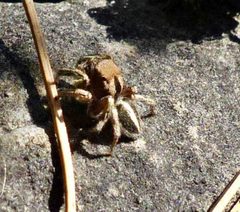
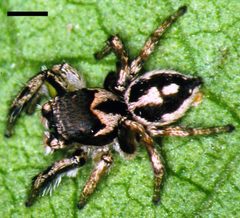
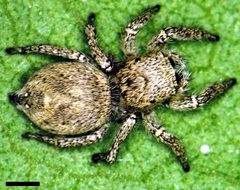
Small jumping spider with sexually dimorphic features. Males display a prominent calcar (spur) on the patella of the third leg, visible without magnification. The calcar is used to display to females during courtship. Body size and coloration details are not extensively documented in available sources.
Habitat
Ground-dwelling spider found in areas of scattered vegetation, including prairies, grasslands, and open fields. Occupies with stones or leaf litter where it prowls for prey.
Distribution
Occurs in the United States and Canada. Three occupy distinct ranges: H. c. agricola in the Great Plains from South Dakota to Texas; H. c. calcaratus in Florida; and H. c. maddisoni in the eastern United States and Canada.
Seasonality
are active during warmer months. Specific is not well documented, but jumping spiders in temperate regions typically have peak activity in late spring through summer.
Behavior
Males perform elaborate combining visual and vibratory signals. The third legs are bent to maximize visibility of the calcar to females. Males simultaneously drum or tap the substrate, producing complex vibratory signals synchronized with visual displays. This multimodal courtship has been described as among the most elaborate of any terrestrial .
Ecological Role
Predatory spider that hunts small insects and other arthropods. Serves as prey for larger and small vertebrates.
Human Relevance
Subject of scientific study due to its complex courtship and . Not medically significant or economically important.
Similar Taxa
- Habronattus cuspidatusAlso possesses a spur on the third leg, but differs in spur and geographic range (more western and northern distribution)
- Other Habronattus speciesMany lack the prominent calcar; male genitalia and facial coloration differ among
More Details
Subspecies
Three are recognized: H. c. agricola (Great Plains), H. c. calcaratus (Florida), and H. c. maddisoni (eastern U.S. and Canada). The subspecies differ in geographic distribution but morphological distinctions are subtle.
Courtship complexity
Habronattus calcaratus belongs to a renowned for elaborate courtship. Males produce vibratory signals likened to orchestral compositions, synchronized with visual displays of the calcar. This multimodal communication may represent the most complex courtship of any terrestrial .
Sources and further reading
- BugGuide
- Wikipedia
- GBIF taxonomy match
- iNaturalist taxon
- NCBI Taxonomy
- Catalogue of Life
- Bug Eric: September 2012
- Buprestidae | Beetles In The Bush | Page 10
- Bug Eric: What a Spider!
- Bug Eric: A Case of Predator Mimicry in the Bee Fly Genus Epacmus? (Diptera: Bombyliidae)
- A jewel of a beetle | Beetles In The Bush
- Mexico | Beetles In The Bush