
Crossopriza lyoni
(Blackwall, 1867)
Tailed Cellar Spider, Tailed Daddy Longlegs Spider, Box Spider
Crossopriza lyoni is a cosmopolitan cellar spider (Pholcidae) characterized by extremely long, fragile legs and a distinctive box-shaped . Females reach 3–7 mm in body length, males 2.5–6 mm, with leg spans up to 6 cm. The is , thriving in human dwellings worldwide, particularly in tropical to subtropical regions. It constructs extensive, irregular cobweb-like webs and is often regarded as both a household pest and beneficial of mosquitoes and other arthropods. Native range unknown; now pantropical through human-mediated introduction.
Pronunciation
How to pronounce Crossopriza lyoni: //kroʊsəˈpraɪzə ˈlaɪəni//
These audio files are automatically generated. While they are not always 100% accurate, they are a good starting point.
Identification
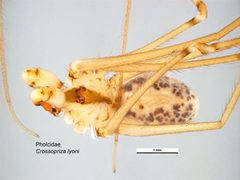
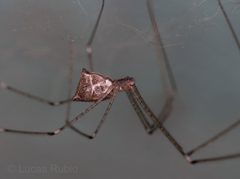
Distinguished from by the angular, box-shaped with a small conical hump (C. cylindrogaster has cylindrical abdomen). Males possess two on each (C. pristina, C. semicaudata, and C. soudanensis have only one). In the New World, C. lyoni is the only Crossopriza present; other species are restricted to Africa or the Middle East. present: males have slightly longer legs, prominent , and 20–25 macrosetae on the . Leg formula I, II, IV, III with gray to amber coloration, brown spots, white girdles at femur and tibia ends, and brown 'knee joints'.
Images
Habitat
Strictly ; inhabits interior and exterior of human-made structures including houses, cellars, basements, and outbuildings. Constructs large, irregular, three-dimensional cobweb-like webs in corners, beneath ceilings, and in undisturbed areas. Readily transported by human activity, especially maritime shipping.
Distribution
Pantropical and through introduction; present in Africa, Asia, Australia, Europe, North and South America, and Pacific islands. Original range unknown, possibly African or Asian. Regulated in several countries.
Diet
Active of flying and crawling arthropods. consume 12–20 mosquitoes (Aedes spp.) daily. Prey includes mosquitoes (Aedes, Anopheles, Culex), other small insects, and arthropods. Spiderlings can overpower prey four times their size within days of first .
Life Cycle
Females deposit 5–6 days after copulation, binding them into loose silk bundles carried with mouthparts. Clutch size 5–54 eggs; incubation 11–13 days. Spiderlings hatch partially but remain in egg sac at least one day, then inactive 2–3 days until first . Development to adulthood approximately 80 days. Lifespan at least 194 days (~6.5 months). Females may consume infertile eggs. among siblings observed.
Behavior
Hunts while hanging inverted in webs; captures prey entangled in silk or pursues flying prey near webs. Subdues prey by throwing silk rather than immediate fang use, wrapping loosely with hind legs; bites only at feeding, sometimes days after capture. Actively cleans webs by removing carcasses; abandons heavily soiled webs and constructs new ones. When threatened, performs rapid vibratory gyration of body in small circles, blurring outline; if ineffective, drops from web or flees with awkward long-legged gait. Mating involves male inserting both , bodies pressed close for ~40 minutes; occasional post-copulatory .
Ecological Role
of mosquitoes and other arthropods in human-modified environments. May contribute to suppression of mosquito-borne ; sometimes encouraged in - areas. Web silk exhibits antibacterial properties against Escherichia coli, Pseudomonas aeruginosa, and Staphylococcus aureus.
Human Relevance
Regulated in several countries. Considered household pest due to extensive, persistent webbing; does not consume old webs, leading to accumulation. Control methods include physical removal, sealing entry points, reducing insect prey (using yellow/sodium vapor lighting), and short-term application. Valued as agent for mosquitoes; recommended for preservation in - regions. Venom potent against insects and other spiders but harmless to humans; popular urban legend regarding extreme venom with ineffective fangs is false. Subject of laboratory breeding protocols for research.
Similar Taxa
- Pholcus phalangioidesAnother widespread cellar spider with long legs, but lacks the box-shaped and conical hump of C. lyoni; abdomen more cylindrical and translucent.
- Opiliones (harvestmen)Non-spider arachnids also called 'daddy longlegs'; body appears as single oval structure without waist, lacks silk production, and has only two .
- Tipulidae (crane flies)Dipteran insects with long legs called 'daddy longlegs'; possess single pair of wings, three body segments, and six legs.
Misconceptions
Popular urban legend claims C. lyoni and other pholcids possess the most toxic venom of any animal but cannot harm humans due to small fangs. This is false: while venom is potent against insects and other spiders (including dangerous like redbacks), it is not harmful to humans, and fangs can penetrate skin.
Sources and further reading
- BugGuide
- Wikipedia
- GBIF taxonomy match
- iNaturalist taxon
- NCBI Taxonomy
- Catalogue of Life
- Heliconiidae | Beetles In The Bush
- Laboratory Breeding and Rearing of Cellar Spider, Crossopriza lyoni Blackwall
- CHROMOSOMES OF CROSSOPRIZA LYONI (BLACKWALL 1867), INTRAINDIVIDUAL NUMERICAL CHROMOSOME VARIATION IN PHYSOCYCLUS GLOBOSUS (TACZANOWSKI 1874), AND THE DISTRIBUTION PATTERN OF NORs (ARANEOMORPHAE, HAPLOGYNAE, PHOLCIDAE)