
Micrathena mitrata
(Hentz, 1850)
white micrathena
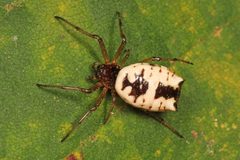
Micrathena mitrata is a small orb-weaving spider in the Araneidae, commonly known as the white micrathena. Females range from 4 to 9 mm in body length, while males are smaller at 3 to 4 mm. The is characterized by a shiny black and spiky, yellowish-brown legs. It constructs circular orb webs to capture flying insects and is found from the United States south to Brazil. Despite its spiny appearance, it poses no danger to humans.
Pronunciation
How to pronounce Micrathena mitrata: /maɪˈkræθɪnə mɪˈtreɪtə/
These audio files are automatically generated. While they are not always 100% accurate, they are a good starting point.
Identification
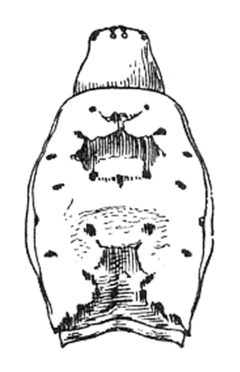
Females of Micrathena mitrata can be recognized by their shiny black and spiky, yellowish-brown legs. Males lack the pronounced spines seen in females and are considerably smaller (3–4 mm versus 4–9 mm). The may be confused with other Micrathena species, but the combination of a predominantly black abdomen with yellowish-brown spiny legs distinguishes it from Micrathena sagittata, which has a more arrow-shaped abdomen with different color patterning, and from Gasteracantha cancriformis, which has a broader, more heavily armored abdomen with prominent spines and different color forms (ivory/black, yellow/black, or red/black).
Images
Habitat
Found in wooded areas, particularly near streams and other bodies of water, where webs are built low to the ground near shrubs or trees. Also occurs in fields, meadows, and grassy areas with sufficient vegetation to support web construction.
Distribution
United States to Brazil. Records from North America, Middle America, and South America including specific localities in Colombia (Cauca, Meta) and Brazil (Acre).
Diet
; feeds on insects and small arthropods captured in its orb web. Prey includes flying insects such as flies, mosquitoes, and .
Life Cycle
Males initiate courtship by tapping the female's web. After mating, females construct fluffy, spherical sacs of white silk approximately 12 mm in diameter, containing roughly 90 eggs. The egg sac serves as the stage.
Behavior
Constructs circular orb webs with a tight spiral and open hub, positioned between vertical and horizontal planes. The spider hangs at the hub, secured by silk strands from its . When threatened, it can drop from the web into leaf litter below and later reel itself back to the hub. Unlike some other web-building spiders, it does not wrap captured prey in silk.
Ecological Role
of flying and jumping insects; contributes to regulation of insect in forest understory and edge .
Human Relevance
Not considered dangerous to humans; generally regarded as harmless. May inadvertently enter homes on evergreen branches or holiday trees as sacs, which can hatch in warm indoor conditions.
Similar Taxa
- Micrathena sagittataBoth are spiny orb-weavers in the same , but M. sagittata has a distinctive arrow-shaped with yellow and black patterning rather than the shiny black abdomen of M. mitrata.
- Gasteracantha cancriformisAnother spiny orb-weaver with superficially similar appearance, but G. cancriformis has a much broader, more heavily armored with thicker, horn-like spines and occurs in more southern regions; color forms include ivory/black, yellow/black, or red/black rather than the consistent black abdomen with yellowish-brown legs of M. mitrata.
Sources and further reading
- BugGuide
- Wikipedia
- GBIF taxonomy match
- iNaturalist taxon
- NCBI Taxonomy
- Catalogue of Life
- Bug Eric: Arrowshaped Micrathena spider
- Bug Eric: Our (New) House
- Bug Eric: Spinybacked Orbweaver
- Bug Eric: Services
- Tinsel, the Christmas spider and other arthropods that decorate your holiday tree — Bug of the Week
- Orbs, Tangles, and Sheets: Spider Web Styles Linked to Anti-Predator Adaptations