
Gasteracantha cancriformis
(Linnaeus, 1758)
Spinybacked Orbweaver, Crab-like Orbweaver, Crab-like Spiny Orbweaver, Smiley Face Spider
Gasteracantha cancriformis is a distinctive orb-weaving spider ( Araneidae) known for its crab-shaped armed with prominent spines. The exhibits striking color , with females displaying white, yellow, orange, or red coloration combined with black markings. Native to the New World tropics and subtropics, it has been introduced to Hawaii. The species has been extensively studied for its genetic basis of color variation and phylogeographic patterns shaped by Andean uplift and .
Pronunciation
How to pronounce Gasteracantha cancriformis: //ˌɡæstərəˈkænθə ˌkæŋkrəˈfɔrmɪs//
These audio files are automatically generated. While they are not always 100% accurate, they are a good starting point.
Identification
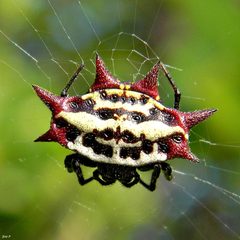
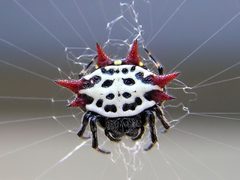
Unmistakable among North American spiders due to the crab-shaped, spiny . Females resemble medieval mace weapons or ninja stars. The combination of flattened body, six prominent spines, and bright coloration with black markings separates it from all other orb-weavers. Micrathena also have spiny abdomens but lack the crab-like shape and extreme flattening. Males are tiny and may be mistaken for debris or different species entirely. sacs are distinctive: oval structures covered in loose yellow silk netting with a central green silk line, attached to leaf undersides.
Images
Appearance
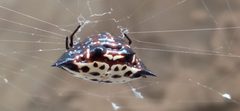
Females possess a highly distinctive flattened, crab-shaped wider than long (10–13 mm width, 5–9 mm length), with six prominent horn-like spines protruding from the hardened, thick . Color forms include ivory with black spines and markings, yellow with black or red spines, or red with black spines. The underside is black with yellow or white spots. Males are dramatically smaller (2–3 mm body length), lack the large spines, and have a less pronounced body structure. The short legs are typically drawn close to the body when at rest.
Habitat
Woodland edges, citrus groves, gardens, and rural areas in subtropical and tropical regions. In the southern United States, found in trees and shrubs, often at considerable heights. Prefers areas with adequate structure for web attachment and nearby vegetation.
Distribution
Native to the New World from the southern United States (Maryland, Arkansas, Oklahoma southward) through Central America, the Caribbean, and South America to Argentina. Introduced and established in Hawaii. Most abundant in Florida, Texas, and other Gulf Coast states. Western limit in North America is southern California.
Seasonality
Most common from late fall through early winter (October–January) in Florida. may be encountered year-round in warmer parts of the range. Overwinters as spiderlings within sacs, not as adults.
Life Cycle
Mated females deposit in distinctive sacs attached to leaf undersides. Each sac is covered with coarse yellow silk in a loose net pattern with a green silk line down the center. Spiderlings emerge and overwinter within the sac, dispersing in spring. mature in late summer and fall. Multiple per year likely in tropical regions; fewer in temperate areas.
Behavior
Constructs orb webs with large open hubs where the spider sits; web spiral is looser than in Micrathena. Web span ranges 30–60 cm. Web often decorated with small silk tufts on near the hub, possibly functioning as bird deterrents or prey lures. Spider typically crouches with legs drawn tight to body, enhancing resemblance to inanimate debris. Males exhibit differential copulatory based on female mating history, adjusting sperm release accordingly.
Ecological Role
of flying insects captured in orb webs. The hardened, spiny and thick likely serve defensive functions against predators. Color may have adaptive significance for defense, with more conspicuous morphs (yellow, orange) showing elevated expression of venom gland genes suggesting aposematic or defensive signaling.
Human Relevance
Harmless to humans; does not bite defensively. Occasionally noticed by homeowners in gardens and on structures. sacs may be encountered on ornamental plants. The has been introduced to Hawaii, where it has established .
Similar Taxa
- Micrathena gracilisAlso an orb-weaver with spiny , but has a more rounded, less flattened body with different spine arrangement; lacks the distinctive crab shape.
- Micrathena sagittataSpiny orb-weaver with pointed rather than flattened ; spines arranged differently and body not crab-like.
- Argiope aurantiaLarge orb-weaver with bold coloration but lacks spines entirely; constructs webs with prominent .
Misconceptions
The spiny appearance leads some to mistake it for a dangerous or venomous , but it is harmless to humans. The spider's habit of crouching motionless causes it to be overlooked as debris or plant material.
More Details
Color Polymorphism Genetics
The exhibits extensive color (white, yellow, orange, red morphs) controlled by multiple genetic including , melanin, ommochrome, and pteridine pigmentation. -seq studies identified differentially expressed genes between morphs, with signatures of positive selection suggesting adaptive significance. More conspicuous morphs show higher venom , implying defensive function.
Phylogeography and Andean Uplift
genetic studies reveal cis- and trans-Andean phylogeographic structure shaped by the Eastern Cordillera uplift approximately 2.13 million years ago. Despite vicariance, shared genetic variation between clades indicates historical divergence with , facilitated by low-elevation passes. This represents the first documented case of Andean uplift coupled with gene flow influencing arachnid diversification.
Sexual Selection and Sperm Competition
Males exhibit sophisticated mating tactics, adjusting copulation duration and sperm release based on female mating history. This behavioral plasticity suggests intense sperm competition and in this .
Sources and further reading
- BugGuide
- GBIF taxonomy match
- iNaturalist taxon
- NCBI Taxonomy
- Catalogue of Life
- Name That Spider Species | Bug Squad
- Bug Eric: Spinybacked Orbweaver
- Bug Eric: February 2014
- Bug Eric: September 2012
- Bug Eric: Services
- Archive — Bug of the Week
- Biological and Behavioral Notes on Gasteracantha cancriformis (Arachnida: Araneidae)
- Dissecting a Geographical Colourful Tapestry: Phylogeography of the Colour Polymorphic Spider Gasteracantha cancriformis
- The Genetic Basis of Color Polymorphism in the Orb‐Web Spider Gasteracantha cancriformis
- Copulation and sperm release in Gasteracantha cancriformis (Araneae: Araneidae): differential male behaviour based on female mating history
- Gene flow and Andean uplift shape the diversification of Gasteracantha cancriformis (Araneae: Araneidae) in Northern South America