
Micrathena sagittata
(Walckenaer, 1841)
Arrow-shaped Micrathena, Arrow-shaped Orbweaver
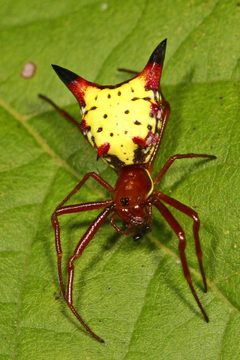
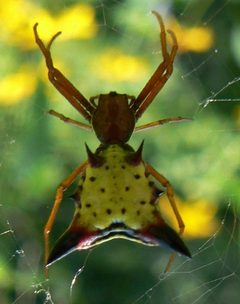
Micrathena sagittata is a small orb-weaving spider in the Araneidae, recognized by its distinctive arrow-shaped with prominent spines. Females reach 8-9 mm in body length, while smaller males lack spines entirely. The constructs circular webs approximately 30 cm in diameter in forest understory vegetation, where it captures flying and jumping insects. It occurs across the eastern United States and Central America, with peak activity from July through September.
Pronunciation
How to pronounce Micrathena sagittata: /maɪˈkræθɪnə ˌsædʒɪˈteɪtə/
These audio files are automatically generated. While they are not always 100% accurate, they are a good starting point.
Identification
The arrow-shaped with three pairs of black-tipped spines distinguishes females from all other North American orbweavers. The central placement of on the venter is unusual among araneids. Males may be confused with small, unidentifiable orbweavers but lack the diagnostic abdominal armature. Similar Micrathena have different spine arrangements: M. gracilis has a more rounded abdomen with different configuration.
Images
Habitat
Deciduous forest understory, forest edges, and openings. Webs are built in shrubs and herbaceous vegetation 60-120 cm above ground. In Kansas, webs have been documented particularly in stands of Green Dragon (Arisaema dracontium), Pennsylvania Pellitory (Parietaria pensylvanica), and American Lopseed (Phryma leptostachya).
Distribution
Eastern United States from Maine to Florida, west to Nebraska and Texas; throughout Central America. More abundant in the southern portion of its North American range.
Seasonality
most commonly observed July through September; sacs represent the stage
Diet
Flying and jumping insects including leafhoppers, flies, small , bees, and beetles. The spider does not wrap captured prey, unlike many other orb-weaving .
Life Cycle
Mated females construct spherical sacs approximately 12 mm in diameter, containing roughly 90 eggs. The white, fluffy silk sac serves as the stage. Spiderlings emerge in spring.
Behavior
Constructs circular orb webs with tight spiral and open hub, typically tilted between vertical and horizontal planes. The spider hangs at the hub, secured by silk threads from its centrally-placed . When threatened, it drops to the leaf litter and later reels itself back to the hub. A zigzag may be present above the web center, possibly functioning as a bird warning or prey attractant. Exhibits prey-capture decision-making: prefers large prey over small when given choice, and captures large prey more successfully in upper web sectors than lower sectors.
Ecological Role
of small flying and jumping insects in forest understory ; contributes to regulation of leafhopper . May serve as prey for spider-hunting wasps and birds.
Human Relevance
Occasionally noticed by hikers and naturalists due to distinctive appearance; sacs may inadvertently enter homes on Christmas trees, where warmth can induce premature hatching
Similar Taxa
- Micrathena gracilisAlso spiny, but has more rounded with different arrangement and lacks the pronounced spines creating arrow shape
- Gasteracantha cancriformisSpiny-backed orbweaver with hardened but has crab-like rounded shape with different spine pattern; posteriorly placed
More Details
Etymology
name from Greek 'micro' (small) + Athena (goddess); name from Latin 'sagittata' meaning arrow-shaped, referring to the abdominal profile
Research Note
Studies in Kansas documented web placement preferences for specific herbaceous plant , suggesting microhabitat selection beyond general forest understory
Sources and further reading
- BugGuide
- Wikipedia
- GBIF taxonomy match
- iNaturalist taxon
- NCBI Taxonomy
- Catalogue of Life
- Grasshopper Collections and Survey
- Bug Eric: Arrowshaped Micrathena spider
- Bug Eric: Services
- Micrathena schreibersi spider - Entomology Today
- Bug Eric: Spinybacked Orbweaver
- Tinsel, the Christmas spider and other arthropods that decorate your holiday tree — Bug of the Week
- Predatory behaviour and prey-capture decision-making by the web-weaving spider Micrathena sagittata