
Micrathena
Sundevall, 1833
spiny orbweavers, spiny orb-weavers
Species Guides
4- Micrathena funebris
- Micrathena gracilis(Spined Micrathena)
- Micrathena mitrata(white micrathena)
- Micrathena sagittata(Arrow-shaped Micrathena)
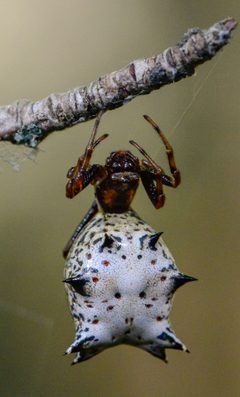
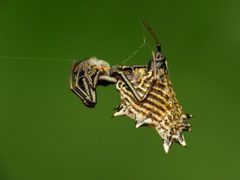
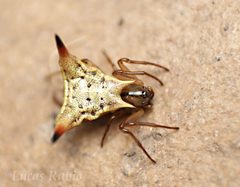
Micrathena is a of orb-weaver spiders containing over 100 , predominantly distributed in Neotropical woodlands. Females are characterized by hardened bearing prominent spines, which have evolved independently at least eight times and function as anti- defenses. These spiders construct vertical orb webs and are diurnally active. The genus originated approximately 25 million years ago and has undergone extensive diversification in Andean cloud forests.
Pronunciation
How to pronounce Micrathena: /maɪˈkræθənə/
These audio files are automatically generated. While they are not always 100% accurate, they are a good starting point.
Identification
Distinguished from the superficially similar Gasteracantha by phylogenetic relationships and web structure: Micrathena webs have a tighter spiral and smaller hub compared to Gasteracantha. Within the , identification relies on spine number and arrangement on the female , geographic distribution, and in some cases, male . Males are difficult to identify without associated females due to reduced ornamentation.
Images
Appearance
Females possess hardened, often brightly colored with prominent spines, , or horn-like projections. The number and arrangement of spines varies among : Micrathena gracilis females have five pairs of conical tubercles, M. mitrata has two short pairs, and M. sagittata has three pairs. Males are significantly smaller than females, lack abdominal spines, and show reduced ornamentation. Body length ranges from approximately 5–9 mm in females to 2–5 mm in males. are positioned centrally on the abdomen rather than posteriorly.
Habitat
Primarily Neotropical woodland , including deciduous forest understory, forest edges, and openings. In North America, occupy similar wooded environments. Webs are constructed in shrubs and vegetation 2–4 feet above ground. Some species show specific plant associations, including Green Dragon (Arisaema dracontium), Pennsylvania Pellitory (Parietaria pensylvanica), and American Lopseed (Phryma leptostachya).
Distribution
Predominantly Neotropical, ranging from Mexico to Argentina including the Antilles. Four occur in the United States and Canada: Micrathena gracilis (widespread), M. sagittata (primarily southern, recorded from Pinery Provincial Park in Canada), M. mitrata, and one additional species. Andean cloud forests represent the primary center of diversification.
Seasonality
Mature spiders most visible from July through September in temperate regions. In subtropical areas such as Florida, activity extends from late summer through early winter. occurs as within silken sacs.
Diet
Flying and jumping insects intercepted in orb webs. Documented prey includes leafhoppers, flies, small and bees, and beetles. Unlike many orb-weavers, Micrathena bite prey before wrapping it.
Life Cycle
Mated females construct spherical sacs of white silk approximately 12 mm in diameter, containing roughly 90 eggs. Egg sacs are placed on vegetation near the web and serve as the stage. Spiderlings emerge from eggs in spring. Sexual maturity is reached in late summer to autumn.
Behavior
Diurnally active. Build vertical orb webs with tight spirals and open hubs, often decorated with —zigzag silk bands above the web center. Web orientation varies with microhabitat: spiders in shaded areas orient north/south, while those in open areas orient east/west, a thermoregulatory . When threatened, spiders drop from the web into leaf litter and later reel themselves back using silk lines. Frame line repair of damaged webs has been documented in M. duodecimspinosa.
Ecological Role
of small flying insects; contributes to regulation of leafhopper and other herbivorous insect . Serves as prey for mud-dauber wasps (Sceliphron spp.), with abdominal spines functioning as mechanical barriers against attacks.
Human Relevance
Occasionally encountered in gardens and natural areas; not considered medically significant. Spider sacs may inadvertently enter homes on Christmas trees, where warmth can induce hatching. Egg sacs can be relocated outdoors to allow natural .
Similar Taxa
- GasteracanthaAlso possesses hardened with spines, but not closely related within Araneidae; distinguished by larger web hub, looser spiral, and different phylogenetic placement
- CyclosaSome construct similar orb webs with , but lack abdominal spines and instead use trash lines or debris for camouflage
More Details
Evolution of spines
Extreme abdominal spines have evolved independently at least eight times in Micrathena, representing of anti- defenses.
Biogeographic history
Approximately 23 events between Central and South America began at least 20 million years ago, predating the complete closure of the Isthmus of Panama. Four over-water dispersal events to the Antilles occurred in the last 20 million years, postdating the proposed GAARlandia land bridge.
Sexual dimorphism and taxonomy
Strong has historically hampered descriptions; 27% of species were described from only one sex. and phylogenetic placement have enabled matching of males to females.
Sources and further reading
- BugGuide
- Wikipedia
- GBIF taxonomy match
- iNaturalist taxon
- NCBI Taxonomy
- Catalogue of Life
- Bug Eric: Arrowshaped Micrathena spider
- Micrathena schreibersi spider - Entomology Today
- Bug Eric: Spinybacked Orbweaver
- Bug Eric: Services
- Tinsel, the Christmas spider and other arthropods that decorate your holiday tree — Bug of the Week
- Orbs, Tangles, and Sheets: Spider Web Styles Linked to Anti-Predator Adaptations
- Macrohabitat Selection by theOrb Weaving Spider, Micrathena Gracilis
- Web Orientation in the Spider Micrathena Gracilis (Araneae: Araneidae)
- Frame line repair by the orb-weaver Micrathena duodecimspinosa (Araneae: Araneidae): possibly ancient behavior
- In their own language: cues guiding sticky spiral placement by Micrathena duodecimspinosa (Araneae: Araneidae)
- The spider Micrathena shealsi Chickering, 1960 (Araneae, Araneidae): description of the male, with new data on its geographic distribution
- Single-Island Endemism despite Repeated Dispersal in Caribbean Micrathena (Araneae: Araneidae): An Updated Phylogeographic Analysis
- Finding hot singles: matching males to females in dimorphic spiders (Araneidae : Micrathena) using phylogenetic placement and DNA barcoding
- Predatory behaviour and prey-capture decision-making by the web-weaving spider Micrathena sagittata
- Abdominal Spines on an Amazonian Spiny Spider (Micrathena schreibersi): A Defense Against Mud‐Dauber Wasps (Sceliphron spp.) Attack?
- Complete phylogeny of Micrathena spiders suggests multiple dispersal events among Neotropical rainforests, islands, and landmasses, and indicates Andean orogeny promotes speciation
- Complete phylogeny of Micrathena spiders suggests multiple dispersal events among Neotropical rainforests, islands and landmasses, and indicates that Andean orogeny promotes speciation