
Micrathena funebris
(Marx, 1898)
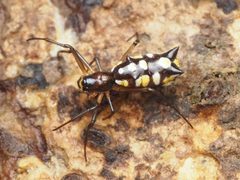
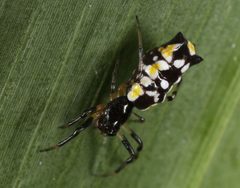
Micrathena funebris is an orb-weaving spider in the Araneidae, distributed from the United States through Central America to Rica. As a member of the spiny orbweaver Micrathena, it shares the characteristic armored with spines or projections typical of this tropical and subtropical group. The was originally described as Acrosoma funebre by Marx in 1898.
Pronunciation
How to pronounce Micrathena funebris: /maɪˈkræθɪnə fjuˈneɪbrɪs/
These audio files are automatically generated. While they are not always 100% accurate, they are a good starting point.
Identification
Micrathena funebris can be distinguished from other Micrathena by its specific abdominal spine configuration and coloration pattern. The Micrathena is characterized by females having hardened, spiny with various projections, while males are smaller and lack these armored structures. Within the genus, M. funebris differs from the more common M. gracilis (Spined Micrathena) and M. sagittata (Arrowshaped Micrathena) in its specific geographic range and morphological details. M. gracilis has a more rounded abdomen with prominent spines, while M. sagittata has a distinctive arrow-shaped abdomen with spines. M. funebris appears to have a more elongated or cylindrical abdominal shape compared to these .
Images
Habitat
Based on -level patterns, Micrathena typically inhabit woodland edges, forest understories, and shrubby vegetation where they can construct their orb webs. They are generally found in humid, vegetated environments with sufficient structure to support web construction.
Distribution
United States to Rica; recorded from Middle America and North America. The spans a broad latitudinal range across the southern United States through Mexico and Central America.
Behavior
As an orb-weaver, M. funebris constructs a circular, wheel-shaped web to capture flying and jumping insects. Females are sedentary web-builders, while males are more mobile and seek out females for mating. Like other Micrathena , the spider likely occupies the hub of its web, secured by silk threads from its centrally located , and can drop from the web when threatened.
Ecological Role
As a of flying and jumping insects, M. funebris contributes to insect in its . Its webs may intercept leafhoppers, flies, small , bees, and beetles. The serves as potential prey for spider-hunting wasps, birds, and other vertebrate predators.
Human Relevance
Micrathena funebris has no documented negative impacts on humans. Like other orb-weavers, it is beneficial for natural pest control in gardens and natural areas. The is not medically significant.
Similar Taxa
- Micrathena gracilisBoth are spiny orbweavers with armored , but M. gracilis has a more rounded abdomen with prominent spines and is more common in eastern North America.
- Micrathena sagittataShares the spiny characteristic, but M. sagittata has a distinctive arrow-shaped abdomen with spines and is found in eastern deciduous forests.
- Gasteracantha cancriformisAnother spiny orbweaver with hardened abdominal projections, but G. cancriformis has a crab-like, flattened body with stout horn-like spines and is more subtropical in distribution.
Sources and further reading
- BugGuide
- Wikipedia
- GBIF taxonomy match
- iNaturalist taxon
- NCBI Taxonomy
- Catalogue of Life
- Bug Eric: Arrowshaped Micrathena spider
- Bug Eric: Spinybacked Orbweaver
- Bug Eric: Services
- Tinsel, the Christmas spider and other arthropods that decorate your holiday tree — Bug of the Week
- Uncategorized | Blog - Part 29
- Orbs, Tangles, and Sheets: Spider Web Styles Linked to Anti-Predator Adaptations