
Micrathena gracilis
(Walckenaer, 1805)
Spined Micrathena
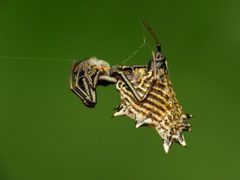
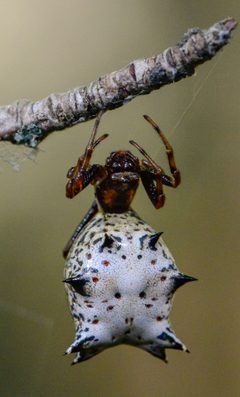
Micrathena gracilis is a small orb-weaving spider in the Araneidae, commonly known as the Spined Micrathena. Females possess distinctive abdominal spines and build moderately large, tightly coiled orb webs up to 30 cm in diameter. The exhibits behavioral through web orientation, positioning webs to optimize solar exposure based on microhabitat conditions. It is harmless to humans and primarily inhabits wooded and brushy areas.
Pronunciation
How to pronounce Micrathena gracilis: /maɪˈkræθɪnə ˈɡræsɪlɪs/
These audio files are automatically generated. While they are not always 100% accurate, they are a good starting point.
Identification
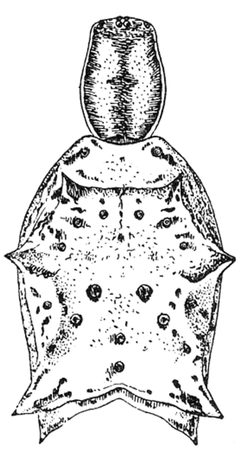
Distinguished from other Micrathena by the specific arrangement of abdominal spines—M. gracilis typically shows five pairs of spines with the pair longest and directed rearward. Differs from M. sagittata (Arrowshaped Micrathena), which has a triangular with three posterior spines forming an arrow shape. Males can be confused with other small orb-weavers but lack the spines characteristic of females. Web structure helps identification: tightly coiled spiral with open hub, often with vague above center.
Images
Appearance
Small orb-weaving spider with females measuring approximately 8-10 mm in body length. Females possess a hardened, spiny with prominent pointed projections—typically five pairs of spines arranged symmetrically. The abdomen is usually white, yellow, or pale with variable dark markings. Males are smaller (4-5 mm), lack abdominal spines entirely, and have a more slender, unadorned abdomen. Legs are relatively long and slender. are centrally located on the abdomen rather than posteriorly positioned.
Habitat
Deciduous forests and wooded areas; mesic (moist) sites with dense shrub vegetation and higher humidity. Prefers areas with greater structural complexity and avoids xeric (dry) sites with open . Webs constructed in understory vegetation, shrubs, and forest edges, typically 2-4 feet above ground. Favors locations with dense vegetation cover and moderate shade.
Distribution
North America and Central America; recorded from United States (eastern deciduous forests, including Maryland, Ohio, Kansas, Massachusetts), Mexico, and Central America. Distribution extends from Maine to Florida and west to Nebraska and Texas in the United States, with higher abundance in southern portions of range.
Seasonality
active primarily July through September; mature spiders most visible during late summer and early autumn. Overwinters as in silken sacs. Spiderlings emerge in spring.
Diet
Flying and jumping insects intercepted in orb web. Documented prey includes leafhoppers, flies, small , bees, and beetles. Unlike many orb-weavers, does not wrap captured prey in silk.
Life Cycle
Mated females construct spherical, fluffy white sacs approximately 12 mm in diameter containing roughly 90 eggs. Egg sac is the stage. Spiderlings emerge from eggs in spring, develop through summer, reaching maturity by late July-September.
Behavior
Builds circular orb webs 20-30 cm in diameter with tight spiral and open hub. Web orientation varies with microhabitat: spiders in shaded closed microhabitats predominantly north-south, while those in well-lit open microhabitats face east-west. This orientation functions as behavioral , optimizing solar radiation exposure and body temperature. Spider hangs at hub using silk strands from centrally-placed ; can drop into leaf litter when threatened and reel back when danger passes. Web often tilted between vertical and horizontal planes. Constructs vague (zigzag silk band) above web center, function debated.
Ecological Role
of small flying and jumping insects; contributes to regulation of leafhopper and other herbivorous insect in forest understory . Web-building activity may influence local insect movement patterns. Serves as prey for birds and other predators.
Human Relevance
Completely harmless to humans; does not bite. Occasionally enters homes on vegetation but is an outdoor that does not survive well indoors. sacs may inadvertently enter homes on Christmas trees or greenery; recommended to place outdoors if found. Provides natural pest control in gardens and wooded areas.
Similar Taxa
- Micrathena sagittataAlso has spiny , but with triangular shape and three spines forming distinct arrow shape; web structure similar but abdominal clearly different
- Gasteracantha cancriformisAnother spiny orb-weaver with crab-like spiny , but has much broader, flattened abdomen with red or white coloration and different spine arrangement; more tropical distribution
Misconceptions
None documented in available sources
More Details
Thermoregulatory Behavior
Research demonstrates that web orientation in M. gracilis is a flexible behavioral thermoregulatory mechanism. Spiders adjust compass orientation of webs to control solar radiation exposure, thereby managing body temperature. This allows exploitation of diverse microhabitats while maximizing time on web and optimizing prey capture.
Prey Handling
Unusual among orb-weavers for not wrapping captured prey in silk. This behavioral difference from typical araneid prey handling may relate to the hard, spiny providing protection while handling prey, or to rapid consumption of small prey items.
Sources and further reading
- BugGuide
- GBIF taxonomy match
- iNaturalist taxon
- NCBI Taxonomy
- Catalogue of Life
- Grasshopper Collections and Survey
- Bug Eric: Services
- Tinsel, the Christmas spider and other arthropods that decorate your holiday tree — Bug of the Week
- Bug Eric: Arrowshaped Micrathena spider
- Bichos Argentinos #2 – Pseudomyrmex sp. | Beetles In The Bush
- Traffic Jam Treehoppers | Beetles In The Bush
- Macrohabitat Selection by theOrb Weaving Spider, Micrathena Gracilis
- Web Orientation in the Spider Micrathena Gracilis (Araneae: Araneidae)