
Gasteracantha
Sundevall, 1833
spiny orb-weavers, spiny-backed orb-weavers, spiny spiders
Species Guides
1- Gasteracantha cancriformis(Spinybacked Orbweaver)
Gasteracantha is a of orb-weaver spiders ( Araneidae) characterized by females with prominent abdominal spines and bright coloration. The genus exhibits strong , with females significantly larger than males and possessing the distinctive spiny, hardened that give the group its . Approximately 67 are recognized, distributed primarily in tropical and subtropical regions worldwide. The genus has a complex taxonomic history with many synonymies, and molecular studies indicate it may be with respect to related genera Macracantha, Actinacantha, and Thelacantha.
Pronunciation
How to pronounce Gasteracantha: //ˌɡæstərəˈkænθə//
These audio files are automatically generated. While they are not always 100% accurate, they are a good starting point.
Identification
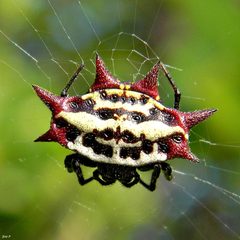
Females are unmistakable due to the combination of six prominent abdominal spines, hardened shell-like , and bright coloration. No other North American orb-weaver combines these traits. Males are tiny, lack spines, and are difficult to identify without examination. Gasteracantha cancriformis specifically can be distinguished from the unrelated Micrathena orb-weavers by its broader, more flattened abdomen with fewer but stouter spines, and its more open web hub. Micrathena typically have more numerous, finer spines and tighter spiral webs.
Images
Appearance
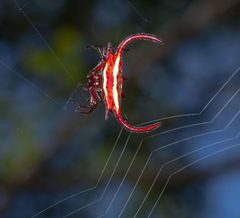
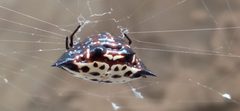
Females possess a broad, flattened, hardened with six prominent spines projecting outward, resembling a crab shell or medieval mace. The abdominal is thick and shell-like, not soft-bodied. Females range 5-13 mm in width (wider than long) and exhibit bright color including ivory and black, yellow with black or red spines, or red with black spines. The underside is black with yellow or white mottled spots, with arising from a central turret. Males are diminutive (2-3 mm body length), lack prominent spines, and are drably colored.
Habitat
Tropical and subtropical woodland edges, citrus groves, gardens, and rural areas with adequate vegetation for web support. In the southern United States, found in low shrubs and bushes, often 2-4 feet above ground. Webs are constructed in open areas between branches or vegetation where flying insects are abundant.
Distribution
Worldwide in tropical and subtropical climates. Most diverse in tropical Asia from India through Indonesia. Gasteracantha cancriformis occurs from the southern United States (Maryland, Arkansas, Oklahoma southward) through Central America to Argentina, and west to southern California. Other occur in Africa, Asia, Australia, and Pacific islands.
Seasonality
Gasteracantha cancriformis is most abundant from October through January in Florida (late fall to early winter). Activity patterns vary by and latitude; generally active year-round in tropical regions, with peak abundance during warmer months in subtropical areas.
Diet
Flying insects intercepted in orb webs, including flies, beetles, small , bees, and leafhoppers. Gasteracantha mammosa has been observed capturing bees despite being stung, and rejects pentatomids (stink bugs) apparently due to their defensive secretions.
Life Cycle
Females deposit in distinctive sacs attached to leaf undersides; the egg sac of G. cancriformis is covered in coarse yellow silk with a central green stripe. Spiderlings overwinter in egg sacs and emerge in spring. In G. minax, aggregated egg sacs experience higher rates than solitary ones.
Behavior
Females construct circular orb webs 30-60 cm in diameter with large open hubs where they sit. Webs often contain white silk tufts on radial threads near the hub, hypothesized to function as warning beacons to prevent bird collisions. Gasteracantha mammosa immobilizes prey exclusively by biting rather than wrapping with silk, and pulls large prey to the hub along a rather than carrying suspended. G. minax exhibits facultative aggregating where females join groups, attach web support threads to existing webs to reduce silk investment, suffer lower rates, and attract more males, though without increased prey capture success.
Ecological Role
of flying insects; contributes to insect . May serve as prey for spider-hunting wasps, though the hardened may provide defense. sacs are parasitized by . visit flowers for nectar and may contribute to pollination.
Human Relevance
Generally harmless to humans; bites are not medically significant. Sometimes called "crab spiders" colloquially but unrelated to true crab spiders (Thomisidae). Occasionally encountered in gardens and ornamental plantings where they may be mistaken for inanimate objects due to their crouched posture.
Similar Taxa
- MicrathenaAlso has spiny, hardened and constructs orb webs, but typically has more numerous finer spines, tighter web spirals, and is not closely related within Araneidae. Micrathena are primarily New World.
- IsoxyaAnother of spiny orb-weavers with superficially similar abdominal armature, but distinct in spine arrangement and genitalic .
- Macracantha, Actinacantha, ThelacanthaRelated that may be nested within Gasteracantha based on molecular ; these share the spiny trait but differ in spine number and arrangement.
Misconceptions
Despite the "crab spider" applied to some , Gasteracantha is not closely related to true crab spiders ( Thomisidae). The hardened abdominal spines were long assumed to be defensive against , but this has not been rigorously tested; the thick itself may be more significant for defense than the spines.
More Details
Taxonomic Complexity
The has a complex taxonomic history with around 70 recognized including dozens of synonyms and based on 18th- and 19th-century literature. Challenges include color , variable spine length and shape within species, lack of male specimens for many species, missing or damaged , and ambiguous original descriptions.
Phylogenetic Uncertainty
A 2019 molecular study found Gasteracantha to be with respect to Macracantha, Actinacantha, and Thelacantha, but no formal taxonomic reassignments were proposed. The is in need of comprehensive revision.
Color Polymorphism Genetics
Transcriptomic analysis of G. cancriformis identified differentially expressed genes in pigmentation including , melanin, ommochromes, and pteridines. Signatures of positive selection suggest adaptive significance, possibly defensive given higher venom gland in conspicuous yellow and orange morphs.
Andean Phylogeography
G. cancriformis shows pronounced phylogeographic structure in northern South America, with cis- and trans-Andean clades diverging approximately 2.13 million years ago during Eastern Cordillera uplift, with ongoing facilitated by low-elevation passes.
Sources and further reading
- BugGuide
- Wikipedia
- GBIF taxonomy match
- iNaturalist taxon
- NCBI Taxonomy
- Catalogue of Life
- Name That Spider Species | Bug Squad
- Destination Big Cypress National Preserve to meet a smiley face spider: Spiny orbweaver, Gasteracantha cancriformis — Bug of the Week
- Bug Eric: Spinybacked Orbweaver
- Bug Eric: Arrowshaped Micrathena spider
- Bug Eric: February 2014
- Bug Eric: Services
- Predatory Behavior of Gasteracantha mammosa C. KOCH (Araneae: Araneidae)
- Biological and Behavioral Notes on Gasteracantha cancriformis (Arachnida: Araneidae)
- Dissecting a Geographical Colourful Tapestry: Phylogeography of the Colour Polymorphic Spider Gasteracantha cancriformis
- Copulation and sperm release in Gasteracantha cancriformis (Araneae: Araneidae): differential male behaviour based on female mating history
- Gene flow and Andean uplift shape the diversification of Gasteracantha cancriformis (Araneae: Araneidae) in Northern South America
- Costs and benefits of facultative aggregating behaviour in the orb‐spinning spider Gasteracantha minax Thorell (Araneae: Araneidae)
- The Genetic Basis of Color Polymorphism in the Orb‐Web Spider Gasteracantha cancriformis