
Lauxaniidae
Lauxaniid Flies
Genus Guides
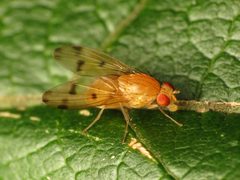
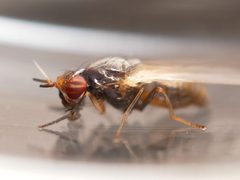
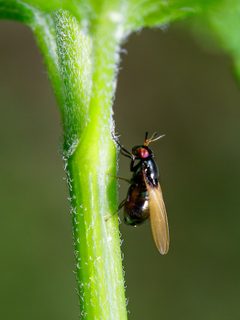
23is a of acalyptrate flies comprising approximately 1800 described across 126 . are small (2–7 mm), often with large, brightly colored and variegated wing patterns. The family has a distribution with highest diversity in tropical Asia and the Americas; declines markedly toward temperate regions. Adults are typically sedentary, associated with shaded, humid forest environments where they feed on leaf-surface fungi. Larvae are primarily saprophagous, developing in decaying plant matter, leaf litter, rotting wood, and bird nests.
Pronunciation
How to pronounce Lauxaniidae: //lɔːkˈsænɪaɪdiː//
These audio files are automatically generated. While they are not always 100% accurate, they are a good starting point.
Identification
Distinguished from other acalyptrate flies by the combination of: complete wing venation with continuous and entire subcosta ending in costa; short second basal and anal ; widely open cell; preapical bristle on all tibiae; convergent postvertical bristles (rarely parallel); and absence of interfrontal bristles. The presence of two pairs of frontal bristles with the upper pair always reclinate is also diagnostic. Large, often brightly colored and variegated wing patterns are characteristic but not unique. Some such as Cestrotus exhibit lichen- or rock-mimicking body camouflage with horizontal stripes.
Images
Appearance
Small flies, 2–7 mm in length, often rather plump with dull to partly lustrous bodies. Body color ranges from yellow to brown or black, or combinations thereof. variable in shape: may project or retreat, convex, flat, or concave; oral vibrissae usually absent (rarely poorly developed or with strong bristles near vibrissal angle). Postvertical bristles convergent (rarely parallel). broad with two pairs of frontal bristles; upper pair always reclinate, lower pair sometimes decussate. Interfrontal bristles absent. Ocellar bristles present or minute. variable; , ranging from pubescent to bare. with bristles at least behind the ; scutellum usually bare except for marginal bristles. Propleural bristles present or absent; one or two sternopleural bristles observed. All tibiae with a preapical bristle. Wings may be marked or unmarked; some with spots along . Wing venation complete with continuous ; subcosta entire, ending in costa. Second basal and anal short; cell usually widely open. oval (rarely elongated). Many species have large that are brightly colored in life, sometimes with characteristic horizontal stripes. Wing patterns are variegated in many species, though bodies are generally not variegated except in such as Cestrotus.
Habitat
Primarily forest , especially humid forests near streams and swamps. frequent shaded places in the understory, typically found sitting on leaves of low foliage, grasses, flowers, and compost capitula. Far less common in open country such as grasslands. Larval habitats include fallen leaves, rotting wood or straw, decaying vegetation, and bird nests.
Distribution
distribution with strong tropical . Highest in tropical regions of Asia and the Americas. Relatively few in Afrotropical regions. Species diversity declines strongly toward temperate regions: fewer than 200 European species described. Neotropical fauna (south of United States, including Mexico without Nearctic/Neotropical distinction) comprises 391 valid species. Colombia reports 63 species. Iran has 17 Sapromyza species. Nearctic fauna present but less diverse. Records from Denmark, Norway, Sweden, Vermont (USA), and USA generally.
Seasonality
more active at the end of the afternoon, making this period optimal for collection. Activity patterns likely vary by latitude and climate; temperate presumably active during warmer months.
Diet
feed on fungi growing on leaf surfaces (scraper fungi). Larvae are primarily saprophagous, feeding on decaying plant material including fallen leaves, rotting wood or straw, and decaying vegetation. Some larvae mine fallen leaves. At least some cause deformation of flowers and pistils of violets.
Life Cycle
Complete (holometabolous): , larva, pupa, . Larvae develop in decaying organic matter. Specific details on egg deposition sites, locations, and developmental duration not documented in available sources.
Behavior
are sedentary, typically remaining on vegetation rather than flying frequently. More active at the end of the afternoon. Congregating observed in some contexts. Adults are associated with shaded, humid microhabitats and are far less common in open .
Ecological Role
Larvae function as decomposers in forest , processing decaying plant material, leaf litter, and rotting wood. contribute to nutrient cycling through consumption of leaf-surface fungi. Some interact with living plants (e.g., violet flower deformation), though ecological significance of this interaction is unclear.
Human Relevance
Minimal direct human impact. Not known as significant agricultural pests or . Some attracted to decaying fruits and vegetables (e.g., pumpkins), where they contribute to decomposition alongside other saprophagous insects. One species (Homoneura) noted as "pumpkin-orange" in color and observed on fermenting pumpkins. Not recognized as household pests of concern.
Similar Taxa
- DrosophilidaeBoth are small acalyptrate flies associated with decaying fruit; distinguished by 's complete wing venation with entire subcosta, preapical tibial bristles, and absence of interfrontal bristles
- HeleomyzidaeSimilar in size and saprophagous habits; separated by 's characteristic wing venation and bristle patterns
- SphaeroceridaeSmall saprophagous flies; distinguished by 's larger , often colorful appearance, and distinct wing venation
Sources and further reading
- BugGuide
- Wikipedia
- GBIF taxonomy match
- iNaturalist taxon
- NCBI Taxonomy
- Catalogue of Life
- Bug Eric: Pumpkin Bugs
- Bug Eric: November 2009
- Bug Eric: 2009
- FAMILY LAUXANIIDAE
- A conspectus of Neotropical Lauxaniidae (Diptera: Lauxanioidea)
- Investigation of the families Asteiidae, Lauxaniidae, Mydidae, and Neriidae (Insecta: Diptera)
- Investigation of the families Asteiidae, Lauxaniidae, Mydidae, and Neriidae (Insecta: Diptera)
- The taxonomy and biology of the Nearctic species of Homoneura (Diptera: Lauxaniidae)
- The genus Sapromyza (Diptera: Lauxaniidae) in Iran with description of three new species
- Three new species of the Homoneura (Homoneura) singularis group from China (Diptera, Lauxaniidae, Homoneura).
- The mitochondrial genome of Minettia omei (Diptera: Lauxaniidae) and its phylogenetic analysis.