
Cryptochetidae
Hennig, 1958
Genus Guides
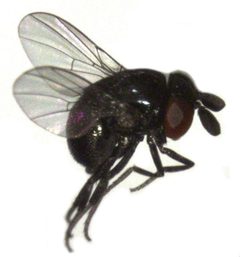
1is a small of minute flies (2–4 mm) in the order Diptera. are typically metallic blue-black with a stout build, broad high , and clear wings. The family is distinguished by reduced or absent on the , a trait reflected in its name meaning 'hidden bristles'. Larvae are endoparasitoids of scale insects (Coccidae), with some used in . Approximately 20–30 species are known across three , primarily distributed in tropical regions.
Pronunciation
How to pronounce Cryptochetidae: //ˌkrɪptoʊˈkiːtɪˌdiː//
These audio files are automatically generated. While they are not always 100% accurate, they are a good starting point.
Identification
Distinguished from other by reduced or absent on ( name refers to 'hidden bristles'). Differs from other Lonchaeoidea by having no more than one proclinate orbital bristle on each side. Single pair of abdominal is diagnostic. Metallic blue-black coloration and stout build with broad high are characteristic. Previously confused with Agromyzidae but now recognized as distinct family.
Images
Appearance
Tiny flies, 2–4 mm in length. Body stoutly built, metallic blue-black in color. broad and high. Wings clear. with cleft in second segment; absent or minute and indistinguishable. densely setulose. with break at end of subcosta. Single pair of abdominal (unique among flies). Male with symmetrical sixth abdominal sternite and distinct 8th tergite. Female with seventh tergite and sternite , eighth segment elongated.
Habitat
Associated with scale insects on plants; found in vicinity of infested vegetation. Specific microhabitat requirements not well documented.
Distribution
Primarily tropical distribution. Recorded from multiple regions including Jordan, Spain, Algeria, and various tropical countries. Precise range poorly documented for most .
Host Associations
- scale insects (Coccidae) - larval endoparasitoidLarvae develop internally within ; specific host range varies by
- mealybugs (Pseudococcidae) - larval endoparasitoidDocumented for some including Cryptochetum jorgepastori
- Icerya - Specific of Cryptochetum iceryae
- Pseudaspidoproctus hyphaeniacus - of Cryptochetum jorgepastori on date palms in Jordan
Life Cycle
Complete with four larval instars. First instar sac-like, lacks trophi and , has pair of finger-like caudal processes. Caudal processes elongate and become filamentous in subsequent instars, exceeding body length in final instar; likely function as respiratory organs. Caudal end of digestive tract closed in early instars. occurs within remains.
Behavior
Larvae are endoparasitoids, developing internally within living scale insects. poorly documented.
Ecological Role
agent of scale insects. Cryptochetum iceryae has been used in programs against Icerya purchasi (cottony cushion scale).
Human Relevance
Used in of agricultural pests, particularly scale insects damaging to crops and ornamental plants. Cryptochetum iceryae historically important in control of cottony cushion scale in citrus.
Similar Taxa
- AgromyzidaePreviously classified within Agromyzidae; distinguished by reduced , single pair of abdominal , and endoparasitoid lifestyle versus leaf-mining habit of Agromyzidae
- LonchaeidaeShares superfamily Lonchaeoidea and cleft second antennal segment; distinguished by reduced and endoparasitoid versus saprophagous or phytophagous habits of Lonchaeidae
- ChamaemyiidaeAlso of Coccoidea; distinguished by antennal structure and abdominal number
Misconceptions
Formerly considered a or group within Agromyzidae; now recognized as distinct based on morphological and biological differences.
More Details
Antennal morphology
The reduced or absent is unique among and represents a major diagnostic feature; second antennal segment has cleft as in other Lonchaeoidea
Respiratory adaptations
Larval caudal filaments in final instar greatly exceed body length, likely serving as respiratory structures in the enclosed environment within scale insects
Taxonomic history
established by Hennig in 1958; three recognized : Cryptochetum (1875), Phanerochaetum (1965), and Librella (1976)