
Rhinocricidae
Brölemann, 1913
Genus Guides
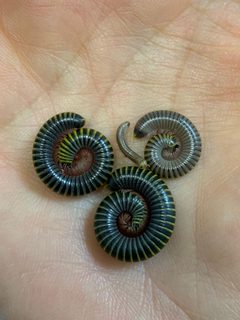
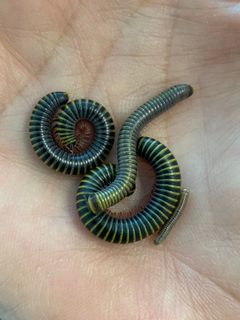
2Rhinocricidae is a of millipedes in the order Spirobolida, established by Brölemann in 1913. The family exhibits a disjunct distribution pattern, occurring in Malesia and neighboring parts of Australasia as well as in the Neotropics. It is one of the most -rich families, with over 500 nominal species classified into 27 and 3 subgenera. Members are characterized by their cylindrical body form typical of spirobolidan millipedes and possess well-developed chemical defense systems.
Pronunciation
How to pronounce Rhinocricidae: //raɪ.nəˈkrɪ.sɪˌdiː//
These audio files are automatically generated. While they are not always 100% accurate, they are a good starting point.
Identification
Rhinocricidae can be distinguished from other spirobolidan primarily by , particularly the structure of the male copulatory appendages. The family includes such as Anadenobolus, Rhinocricus, and Acladocricus, which are differentiated by specific modifications of the gonopods, telopodites, and other secondary sexual characteristics. Accurate identification to genus and level requires examination of mature males and often detailed dissection of gonopods.
Images
Distribution
Disjunct distribution in two major regions: (1) Malesia and neighboring parts of Australasia including the Philippines, Taiwan, New Guinea, Solomon Islands, Samoa, and Australia; and (2) the Neotropics including the Caribbean islands (Jamaica, Bermuda, Dominica), Central America (Mexico, Rica, Panama, Nicaragua), and South America (Venezuela, Colombia, Brazil, Peru, Ecuador, Bolivia). The is absent from mainland Africa and most of Asia outside Malesia.
Behavior
Members of Rhinocricidae produce defensive secretions containing toxic quinones that serve as chemical defense against . These secretions have been observed to repel arthropods effectively.
Human Relevance
Defensive secretions of Rhinocricidae millipedes are used by wild blonde capuchins (Sapajus flavius) for self-anointing , where the primates rub millipedes against their fur, presumably as a form of control.
Similar Taxa
- SpirobolidaeAlso in order Spirobolida; distinguished from Rhinocricidae by and geographic distribution patterns
- AtopetholidaeAnother in Spirobolida; Rhinocricidae differs in telopodite structure and distribution
More Details
Taxonomic diversity
The contains 528 nominal and 23 placed in 27 and 3 subgenera, making it one of the most diverse families.
Defensive chemistry
The quinone-based defensive secretions are characteristic of the order Spirobolida and represent an effective chemical defense system that has been exploited by primates for medicinal purposes.
Sources and further reading
- BugGuide
- Wikipedia
- GBIF taxonomy match
- iNaturalist taxon
- NCBI Taxonomy
- Catalogue of Life
- Rhinocricidae Systematics II: A species catalog of the Rhinocricidae (Diplopoda: Spirobolida) with synonymies
- Colombocricus gen. nov., a new genus of millipede from Colombia (Diplopoda: Spirobolida: Rhinocricidae)
- Wild Blonde Capuchins (Sapajus flavius) Perform Anointing Behaviour Using Toxic Secretions of a Millipede (Spirobolida: Rhinocricidae)
- Distribution of the Chuuk Islands Giant Millipede, Acladocricus setigerus (Spirobolida: Rhinocricidae), and Identification of Its Defensive Compounds
- Redescription of Ransomnema bravoae Sánchez-Velázquez, 1981 (Ransomnematoidea: Ransomnematidae) from Anadenobolus putealis Loomis, 1969 (Diplopoda: Rhinocricidae) from Mexico
- Studies on spiroboloid millipeds. XI. On the status of Spirobolus nattereri Humbert e Desaussure, 1870, and some species traditionally associated with it (Rhinocricidae)
- Carnoya cepacapitatus n. sp. and C. mexicana n. sp. (Ransomnematoidea: Carnoyidae) from Anadenobolus putealis Loomis, 1969 (Diplopoda: Rhinocricidae) from Mexico