
Polyxenus lagurus
(Linnaeus, 1758)
Bristly Millipede
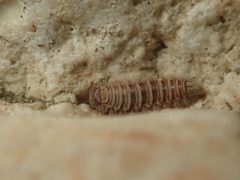
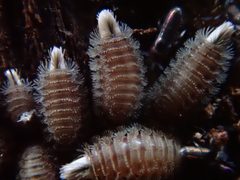
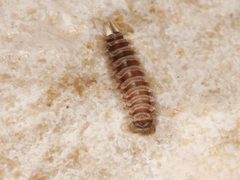
Polyxenus lagurus, commonly known as the bristly , is a small millipede distinguished by its detachable defensive bristles that entangle attacking ants and spiders. It exhibits a unique reproductive , with some reproducing sexually and others parthenogenetically. This species undergoes hemianamorphosis, adding segments and legs through until reaching a fixed complement of 13 leg pairs and 10 tergites, after which molting continues without further segment addition. It is the most common polyxenid in Europe and the only representative of order Polyxenida in the British Isles.
Pronunciation
How to pronounce Polyxenus lagurus: //pɒlɪˈksɛnəs ləˈɡjʊrəs//
These audio files are automatically generated. While they are not always 100% accurate, they are a good starting point.
Identification
Distinguished from other millipedes by: small size (2–4 mm); flattened body; presence of prominent detachable bristles in tufted arrangement; only 13 leg pairs in (far fewer than most millipedes); 10 tergites. The bristle brushes on the are particularly distinctive. Difficult to distinguish from other Polyxenus without close examination; P. lagurus is the only Polyxenida species in the British Isles.
Images
Habitat
Primarily found under bark of dead trees, especially coniferous trees. Also occurs in forest leaf litter, under stones, on rocks, and on old stone or brick walls. In coastal regions, found at roots of halophile plants and on lichens and moss on boulders. Associated with pine needle litter in Mediterranean conifer formations.
Distribution
Holarctic distribution. Europe: widespread, most common polyxenid ; only Polyxenida representative in British Isles. North America: recorded in Massachusetts, New York, New Jersey, Ohio, Michigan, Illinois, Colorado, Montana, Arizona, Washington (USA); Nova Scotia, Québec, Ontario, British Columbia (Canada). Introduced to Melbourne, Australia.
Seasonality
Most easily found at night, especially in humid conditions. Also active during daytime in warm, dry conditions and direct sunlight.
Diet
Believed to feed on lichens, , and small fungi based on associations and authority opinion.
Life Cycle
Development through hemianamorphosis: juveniles hatch with 3 leg pairs and 4 tergites, then add segments and legs through seven , reaching form with 13 leg pairs and 10 tergites in eighth stage. Intermediate stages possess 3, 4, 5, 6, 8, 10, 12, and 13 leg pairs. Adults continue to molt without adding segments or legs.
Behavior
Ecological Role
Decomposer; contributes to breakdown of lichens, , and fungi in forest . Serves as prey for specialized predatory ants, particularly the ponerine ant Thaumatomyrmex in the Neotropics.
Human Relevance
Subject of scientific interest due to unique reproductive (sexual vs. parthenogenetic ) and defensive bristle mechanism. Introduced population in Australia indicates human-mediated .
Similar Taxa
- Other Polyxenus speciesSimilar small size, flattened form, and bristle coverage; require detailed examination for separation, though P. lagurus is the only in this in many parts of its range (e.g., British Isles).
- Other millipede orders (e.g., Polydesmida, Julida)Distinguished by far greater number of leg pairs (typically 30+ in ), cylindrical rather than flattened body, and lack of prominent detachable defensive bristles.
Sources and further reading
- BugGuide
- Wikipedia
- GBIF taxonomy match
- iNaturalist taxon
- NCBI Taxonomy
- Catalogue of Life
- Brazil Bugs #12 – Desafio de identificação #5 | Beetles In The Bush
- Aspects of Ecology of Polyxenus Lagurus in Mediterranean Conifer Formations of Greece (Diplopoda: Penicillata)
- Rickettsiales-like microorganisms associated with the Malpighian tubules of the millipede, Polyxenus lagurus (Diplopoda, Penicillata)