
Polyxenus
Latzel, 1884
Species Guides
1- Polyxenus lagurus(Bristly Millipede)
Polyxenus is a of bristly millipedes in the order Polyxenida, the sole extant genus of the Polyxenidae. These small millipedes are characterized by their distinctive tufts of setae (bristles) and are notable for being among the most morphologically derived millipedes, having lost many ancestral diplopod traits. The genus contains at least 30 valid and has a broad geographic distribution across multiple continents. Polyxenus species are frequently found in association with ants, serving as either or specialized prey.
Pronunciation
How to pronounce Polyxenus: /pɒlɪˈziːnəs/
These audio files are automatically generated. While they are not always 100% accurate, they are a good starting point.
Identification
Distinguished from all other millipedes by the combination of flattened body, dense setal tufts (the "bristle tail"), and inability to coil. Within Polyxenida, -level identification requires examination of microscopic characters including setal arrangement, tergite ornamentation, and male structure. Distinguished from the extinct Phryssonotus by extant status and geographic distribution. The bristle tail is unique among extant millipedes and immediately diagnostic for the order.
Images
Appearance
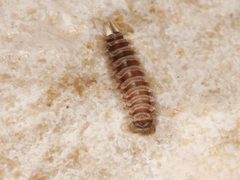
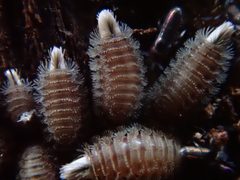
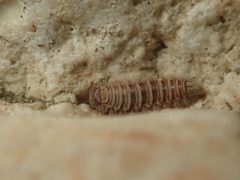
Small millipedes, typically 2–4 mm in length. Body flattened and covered with dense, hair-like setae arranged in tufts or brushes, particularly prominent on the segments forming a characteristic "bristle tail." Unlike most millipedes, they lack the ability to coil into a spiral. relatively soft compared to other millipedes. Coloration variable, often matching substrate. short. Legs relatively short and, in some , the first pair may be modified. Tergites with distinctive -like or setose ornamentation.
Habitat
Found in microhabitats with high humidity and shelter, including under bark, in leaf litter, rotting wood, and soil crevices. In Mediterranean regions, occurs in coniferous forest formations, particularly pine forests. Often associated with nests or in close proximity to ant colonies.
Distribution
Broadly distributed across multiple continents including Europe (Greece, France, United Kingdom, Italy, Czech Republic), Asia (Iran, India with fossil records from Kerala), North America (United States), and Russia. Fossil evidence from Upper Tertiary (Miocene) resin deposits in India indicates ancient presence in the region.
Diet
Feeding habits poorly documented; presumed to consume decaying organic matter, , or lichens based on microhabitat association. Specific dietary items not confirmed in available sources.
Host Associations
- Lasius flavus - associationEuropean associated with this
- Lasius fuliginosus - associationEuropean associated with this
- Temnothorax - association-level association reported
- Thaumatomyrmex - preySpecialized ponerine ant in Neotropics; Polyxenus serves as specific prey
Life Cycle
Developmental stages include and multiple instars. First instar millipedes possess only six legs (hexapod), a plesiomorphic trait among diplopods, with additional leg pairs added through subsequent . Complete details not documented in available sources.
Behavior
When disturbed, does not coil like typical millipedes; instead relies on bristle tufts for defense. The dense setae may serve to entangle or provide mechanical protection. Association with ants includes both symbiotic relationships and , with some serving as specialized prey for predators.
Ecological Role
Functions as decomposer in forest floor . Serves as specialized prey for certain , contributing to structure. Association with ants suggests potential role in nutrient cycling within ant-modified soil environments.
Human Relevance
Minimal direct human relevance. Of scientific interest for studies on evolution, -millipede interactions, and as indicators of forest floor health. Fossil (P. miocenica) contributes to understanding of Tertiary faunas. Intracellular microorganisms (Rickettsiales-like) found in have been studied for their potential as or .
Similar Taxa
- PhryssonotusExtinct also in Polyxenidae; distinguished by fossil status and morphological differences in tergite structure
- Other millipede ordersAll other millipedes can coil into spiral and lack the characteristic bristle tail of Polyxenida
More Details
Etymology
name derived from Greek mythology; Polyxenus was one of the first priests of Demeter and among the first to learn the secrets of the Eleusinian Mysteries.
Evolutionary significance
Polyxenus represents a highly derived lineage of millipedes that has lost many ancestral diplopod characteristics, making it important for understanding evolution.
Intracellular symbionts
Rickettsiales-like microorganisms have been documented in the of P. lagurus, representing potential of intracellular associates.
Fossil record
Fossil P. miocenica described from Miocene resin deposits in Kerala, India, indicating long evolutionary history of the .
Sources and further reading
- BugGuide
- Wikipedia
- GBIF taxonomy match
- iNaturalist taxon
- NCBI Taxonomy
- Catalogue of Life
- Brazil Bugs #12 – Desafio de identificação #5 | Beetles In The Bush
- Rickettsiales-like microorganisms associated with the Malpighian tubules of the millipede, Polyxenus lagurus (Diplopoda, Penicillata)
- Aspects of Ecology of Polyxenus Lagurus in Mediterranean Conifer Formations of Greece (Diplopoda: Penicillata)
- Record of Pillbug (Armadillidium) and Millipede (Polyxenus) Remains from the Resin Lumps of Warkalli Formation (Upper Tertiary), Kerala Coast