
Polyxenidae
Lucas, 1840
pincushion millipedes, bristly millipedes
Genus Guides
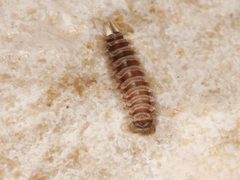
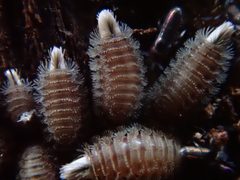
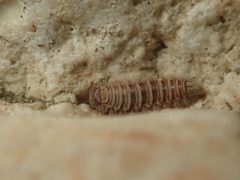
1Polyxenidae is a of small millipedes in the subclass Penicillata, characterized by distinctive bundles of bristles (setae) at the end. range from 1.2–4.2 mm in length and possess 13 pairs of legs with 10 tergites to the . The family contains approximately 109 across 23 , distributed worldwide except Antarctica. Males produce delivered via specialized pores on leg pairs 6–11.
Pronunciation
How to pronounce Polyxenidae: //pɒlɪkˈsɛnɪdiː//
These audio files are automatically generated. While they are not always 100% accurate, they are a good starting point.
Identification
Distinguished from other by the combination of small body size (under 5 mm), presence of 13 leg pairs in , and the characteristic tuft of elongated setae resembling a pincushion. The 10 tergites to the and reduced body segmentation separate them from other millipede orders. Males possess 2–6 pairs of genital pores on leg pairs 6–11, a trait unique to this family within Penicillata.
Images
Habitat
Found in diverse microhabitats including leaf litter, soil crevices, under bark, and decaying wood. In the Neotropics, frequently observed in association with colonies.
Distribution
Worldwide distribution across all continents except Antarctica. Documented from Europe (including Crimean Peninsula and Caucasus), Australia, Brazil, East China, and North America.
Host Associations
- Thaumatomyrmex - preySpecialized ponerine ant known to prey on Polyxenidae in Neotropics
- Lasius flavus - associatedEuropean associated with Polyxenus lagurus
- Lasius fuliginosus - associatedEuropean associated with Polyxenus lagurus
- Temnothorax - associated associated with Polyxenus
- Charletonia rocciai - Erythraeid mite reported as on Polyxenidae in Brazil
Life Cycle
Development includes stages with distinct and pupoid phases, each lasting 12–14 days in observed . The pupoid stage features an embryonic with spines that rupture the chorion. Post-embryonic development involves anamorphic addition of segments and legs. First instar millipedes are hexapod, acquiring additional leg pairs through subsequent .
Behavior
Males deposit on fine threads excreted from genital pores on legs. Penicillate sexual has been described in observed .
Similar Taxa
- other millipede familiesPolyxenidae are distinguished by small size, reduced segmentation, and bristle tufts; other typically have more segments, larger body size, and lack the characteristic pincushion appearance of Penicillata
- SymphylaSymphylans are also small myriapods with 12 pairs of legs and reduced segmentation, but lack the bristle bundles and have different structure and
Sources and further reading
- BugGuide
- Wikipedia
- GBIF taxonomy match
- iNaturalist taxon
- NCBI Taxonomy
- Catalogue of Life
- Brazil Bugs #12 – Desafio de identificação #5 | Beetles In The Bush
- The millipede family Polyxenidae (Diplopoda, Polyxenida) in the faunas of the Crimean Peninsula and Caucasus, with notes on other European Polyxenidae
- Reproduction, egg morphology and development observed in Monographis queenslandicus (Diplopoda: Polyxenidae)
- <strong>Taxonomy and biology of a new species of Pincushion Millipede of the genus <em>Monographis</em> (Diplopoda: Polyxenidae) from Australia</strong>
- First report of Polyxenidae (Diplopoda: Polyxenida) as a host for Charletonia rocciai Treat & Flechtmann, 1979 (Trombidiformes: Erythraeidae) in Brazil
- A new species of Eudigraphis (Diplopoda, Polyxenida, Polyxenidae) from East China, with embryonic and post-embryonic development observations, and mitogenomic and genetic divergence analyses.