
Apheloria montana
(Bollman, 1887)
mountain cherry millipede
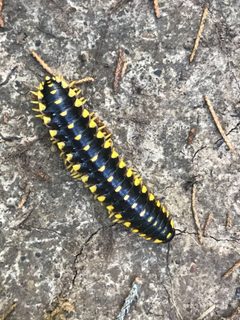
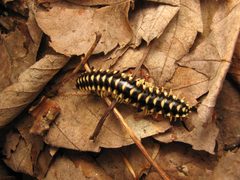
Apheloria montana is a large flat-backed millipede in the Xystodesmidae, native to the southern Appalachian Mountains of eastern Tennessee and western North Carolina. It serves as the type for the Apheloria. The species produces hydrogen cyanide and benzaldehyde as chemical defenses, which emit a characteristic cherry or almond odor. Its bright yellow or orange spots function as aposematic coloration warning of its .

Pronunciation
How to pronounce Apheloria montana: //ˌæfɪˈlɔriə mɒnˈtænə//
These audio files are automatically generated. While they are not always 100% accurate, they are a good starting point.
Identification
Distinguished from by . The junction between acropodite and prefemur features a distinct in A. montana versus an acute angle in A. polychroma. The acropodite is smoothly circular in A. montana but has a distinct elbow-like bend in A. virginiensis. The bright yellow or orange aposematic coloration combined with black surface separates it from non-aposematic polydesmid millipedes in the same region.
Images
Appearance
measure 42–55 mm in length and weigh approximately one gram. The surface is predominantly black with yellow legs. Yellow spots appear on the paranota (lateral extensions of body segments) and along the midline of the back—one spot on the collum and one on each metazonite. A color variant in Little Switzerland, North Carolina, displays smaller orange spots and orange legs instead of yellow. Females are generally larger than males. Adults possess 20 body segments (counting collum as first and as last). Adult females have 31 pairs of legs; adult males have 30 leg pairs, with leg pair 8 modified into . The gonopod acropodite ( portion) is uniformly narrow and curved into a circular shape; the prefemur ( portion) bears a scythe-shaped projection.
Habitat
Inhabits mesic deciduous forests, typically found under decaying leaf litter on the forest floor. Also occurs in less moist including mixed forests and rhododendron groves. Documented in association with pine, maple, oak, beech, tulip poplar, witch hazel, alder, sweetgum, and buckeye.
Distribution
to the southern Appalachian Mountains. In Tennessee: Cocke, Greene, Unicoi, and Washington counties. In North Carolina: Buncombe, Madison, McDowell, and Mitchell counties.
Diet
Feeds on leaf litter. Relies on (consumption of fecal pellets) for survival; individuals deprived of in laboratory conditions became inactive and ceased feces production after 21 days, with some losing weight or dying within one week. Does not appear to rely on internal for cellulose digestion; instead utilizes bacterial activity in fecal pellets.
Behavior
Produces hydrogen cyanide and benzaldehyde as chemical defense against . These compounds are released when the is disturbed and produce a characteristic cherry or almond odor. The bright coloration serves as aposematic (warning) signaling to .
Ecological Role
Functions as a in forest , processing leaf litter. Coprophagic suggests role in nutrient cycling through microbial processing of fecal material. The ' chemical defenses and aposematic coloration represent a documented case of defensive mutualism with co-occurring toxic millipedes in related (Pleuroloma, Boraria, Cherokia), where shared warning signals may enhance learning.
Similar Taxa
- Apheloria polychromaOverlaps in eastern Tennessee; distinguished by acute angle (not ) at acropodite-prefemur junction
- Apheloria virginiensisOccurs in North Carolina; distinguished by elbow-bent (not smoothly circular) acropodite
- Pleuroloma flavipesSimilar black-and-yellow aposematic coloration and flat-backed in the same ; distinguished by -level characteristics and geographic separation
More Details
Type species designation
Designated as type for Apheloria when Ralph V. Chamberlin established the genus in 1921, transferring it from Fontaria montana.
Original description
First described by Charles H. Bollman in 1887 based on a male from Wolf Creek near Del Rio, Cocke County, Tennessee; holotype deposited at Smithsonian Institution.
Phylogenetic relationships
2025 molecular phylogenetic analysis placed A. montana in a clade with A. polychroma; these two form a sister group to A. virginiensis, with A. whiteheadi occupying a more basal position in the .
Chemical defense mechanism
Hydrogen cyanide production is shared across the Apheloria and Xystodesmidae; the cherry/almond odor comes from benzaldehyde, which is produced alongside HCN.
Sources and further reading
- BugGuide
- Wikipedia
- GBIF taxonomy match
- iNaturalist taxon
- NCBI Taxonomy
- Catalogue of Life
- Bumble Bee Mellowing Out on the Mallow | Bug Squad
- Little Spurthroated Grasshopper
- Study Identifies Areas in U.S. Most Suitable for Invasive Giant Hornet
- Cattle Grazing Helps Pollinators in Sagebrush Rangelands
- Polydesmida | Beetles In The Bush
- Cicadas Race to Catch Up With Their Evolving Endosymbionts