
Brachycybe petasata
Loomis, 1936
Brachycybe petasata is a small in the order Platydesmida, to the southern Appalachian Mountains of the southeastern United States. It inhabits moist forest floor , particularly leaf litter and decaying wood in beech, birch, maple, and hemlock forests. The is distinguished by its production of four unique monoterpene alkaloids as chemical defenses: gosodesmine, hydrogosodesmine, homogosodesmine, and hydrohomogosodesmine. As a member of the subterclass Colobognatha, it represents one of the few millipede lineages known to synthesize terpenoid alkaloids.
Pronunciation
How to pronounce Brachycybe petasata: /ˈbrækiˌsaɪbi pɛtəˈsɑtə/
These audio files are automatically generated. While they are not always 100% accurate, they are a good starting point.
Identification
Distinguished from other Brachycybe by geographic distribution in the southern Appalachians. The species produces a specific defensive secretion profile containing four monoterpene alkaloids (gosodesmine, hydrogosodesmine, homogosodesmine, and hydrohomogosodesmine) that differs from its western sister species B. producta only in relative proportions, not composition. Field identification to species level requires expert examination or chemical analysis.
Images
Appearance
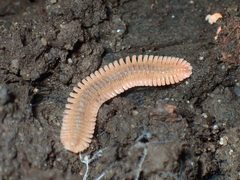
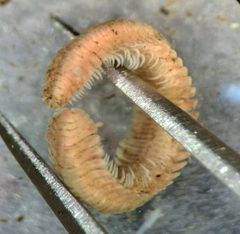
Small, elongate with reduced body size typical of the Brachycybe. Body form is characteristic of Platydesmida, with relatively few body segments compared to many millipede orders. Like other colobognath millipedes, possesses specialized defensive glands (ozopores) that release chemical secretions when disturbed.
Habitat
Moist forest leaf litter and decaying wood. Specifically documented from rhododendron coves and forests dominated by beech, birch, maple, and hemlock. Associated with decaying wood substrates.
Distribution
Southern Appalachian region of the southeastern United States. Recorded from Tennessee (Great Smoky Mountains National Park, Mount LeConte along Alum Cave Trail), North Carolina (Great Balsam Mountains, Balsam Mountain Campground, Haywood County), and Georgia (Cloudland Canyon State Park, Dade County).
Diet
Presumed fungivorous based on -level association with decaying wood and fungal substrates. Direct dietary observations for this are lacking.
Behavior
When disturbed, releases defensive secretions through ozopores. Chemical composition of secretions tracks phylogenetic relationships rather than geographic proximity.
Ecological Role
Contributes to decomposition processes in forest floor through association with decaying wood and leaf litter. Potential role in fungal spore given presumed fungivorous diet.
Human Relevance
Subject of chemical research; 2024 study documented its unique defensive alkaloid profile. No documented economic or medical significance.
Similar Taxa
- Brachycybe productaWestern sister sharing identical major defensive alkaloids; distinguished by geographic separation (western North America vs. southern Appalachians) and subtle differences in alkaloid proportions
- Other Brachycybe speciesOther members of occur in different geographic regions and produce different defensive alkaloid profiles
More Details
Defensive Chemistry
2024 chemical analysis identified four monoterpene alkaloids: gosodesmine, hydrogosodesmine, homogosodesmine, and hydrohomogosodesmine. These compounds are produced in specialized defensive glands characteristic of Colobognatha, a subterclass unique among millipedes for synthesizing terpenoid alkaloids. The alkaloid profile is chemically distinct from geographic neighbors but matches its western sister B. producta, supporting phylogenetic rather than geographic patterns in defensive chemistry evolution.
Ecological Research Need
Richard L. Hoffman noted recurring associations between Brachycybe and beech woods, suggesting this relationship warrants dedicated ecological study to understand potential -specificity or preferences.