
Andrognathidae
Cope, 1869
Genus Guides
4- Andrognathus
- Brachycybe(feather millipedes)
- Gosodesmus(pink feather boa millipede)
- Ischnocybe
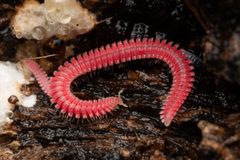
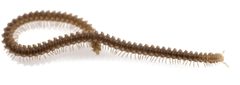
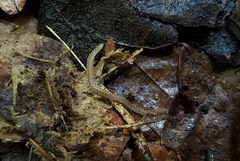
Andrognathidae is a of small, thin-bodied millipedes in the order Platydesmida, suborder Colobognatha. The family contains approximately 17 and over 30 described , primarily distributed in the Holarctic region. Members are characterized by narrow sternites that make appear nearly contiguous, trunk ring pleurites with tergites, and a gnathochilarium composed of five . Some genera exhibit unusual social , including stellate formations and paternal -.
Pronunciation
How to pronounce Andrognathidae: /ænˌdroʊɡˈnæθɪˌdiː/
These audio files are automatically generated. While they are not always 100% accurate, they are a good starting point.
Identification
Distinguished from the other platydesmidan , Platydesmidae, by family-level characters including sternite structure and gnathochilarium composition. Within the family, are distinguished by male genitalia characters, which require microscopic examination. Andrognathus are identified by subtle variation in male genitalia and geographic distribution.
Images
Habitat
Deciduous forests, particularly in mesic conditions. Found in decaying hardwood logs and large fallen branches. Occurs inside decaying wood and beneath bark, burrowing into dead organic matter and humus. Some occupy dry under pine logs. Not typically found beneath leaf litter.
Distribution
Primarily Holarctic. Andrognathus : eastern United States (Florida panhandle to southern Indiana and Pennsylvania), New Mexico, and Nuevo Leon, Mexico. Dolistenus genus: Mediterranean region with relict distributions. Two genera (Brachycybe, Pseudodesmus): Southeast Asia.
Life Cycle
Euanamorphic: individuals add leg-pairs and segments throughout their lifespan for an indeterminate amount of time.
Behavior
Some (Brachycybe, Pseudodesmus) form stellate pinwheel with cephalic ends pointing inward; Andrognathus corticarius has not been observed in such formations. Aggregations of and juveniles occur beneath bark. Chemical defenses involve secretion of heterocyclic nitrogen-containing alkaloids from ozopores.
Similar Taxa
- PlatydesmidaeThe other in order Platydesmida; distinguished by differences in sternite structure and gnathochilarium composition.
More Details
Subfamilies
divided into three : Dolisteninae, Bazillozoniinae, and Andrognathinae. Andrognathinae contains only the Andrognathus.
Paternal Care
Male - has been documented in Yamasinaium noduligerum (Japan), representing the first record of this in Andrognathidae. Males carry eggs in modified and curl the body around egg masses.
Sources and further reading
- BugGuide
- Wikipedia
- GBIF taxonomy match
- iNaturalist taxon
- NCBI Taxonomy
- Catalogue of Life
- Male egg‐brooding in the millipede Yamasinaium noduligerum (Diplopoda: Andrognathidae)
- Cryptic diversity in Andrognathus corticarius Cope, 1869 and description of a new Andrognathus species from New Mexico (Diplopoda, Platydesmida, Andrognathidae)
- A new Mediterranean species of Dolistenus (Diplopoda, Platydesmida, Andrognathidae), with an updated key for the genus and the first contribution for a barcode database of European Platydesmida