
Andrognathus corticarius
Cope, 1869
Cope's Noodle Millipede
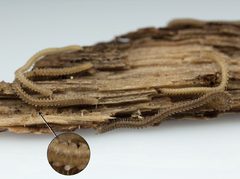
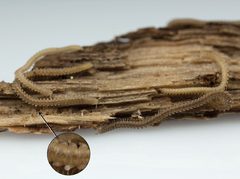
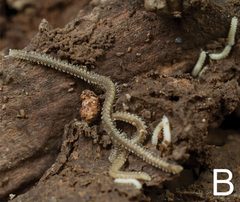
Andrognathus corticarius is a small, thin-bodied platydesmidan broadly distributed in mixed mesophytic deciduous forests of the eastern United States. measure 11–27 mm in length with 45–70 body rings and are less than 1 mm in width. The is euanamorphic, adding segments throughout its lifespan. COI analysis has revealed little genetic variation across its range, though high-magnification imaging of male genitalia suggests potential cryptic diversity. A neotype was designated from Yellow Sulfur Springs, Virginia, as the original type material was lost.
Pronunciation
How to pronounce Andrognathus corticarius: /ˌændroʊˈɡnæθəs kɔrˈtɪkəriəs/
These audio files are automatically generated. While they are not always 100% accurate, they are a good starting point.
Identification
Distinguished by bilobed paranota on the fifth body ring with ozopores elevated on stalks and directed anteriorly. Cream to dark brown in color with lighter paranota. possess 45–70 body rings and are less than 1 mm wide. Male located on rings 9 and 10; genitalic requires high-magnification imaging for precise identification. Similar in general form to A. grubbsi and A. hoffmani, but differs in geographic distribution and subtle genitalic characters.
Images
Habitat
Deciduous forests, specifically beneath bark of decaying hardwood logs and inside decaying wood. Prefers logs just beginning to lose bark and soften due to decomposition. Occasionally found under pine logs in drier . Not typically encountered in leaf litter.
Distribution
Eastern United States, ranging from the Florida panhandle north to southern Indiana and Pennsylvania. Peripheral localities include Liberty County, Florida (southernmost); DeKalb County, Alabama (westernmost); Kanawha County, West Virginia (northernmost); and Campbell County, Virginia (easternmost). Type locality: Montgomery County, Virginia (neotype from Yellow Sulfur Springs).
Life Cycle
Euanamorphic: adds leg-pairs and body segments throughout the lifespan for an indeterminate period. and juveniles co-occur in beneath bark.
Behavior
Forms of and juveniles beneath bark of decaying logs. Does not form the stellate or pinwheel aggregations characteristic of related Brachycybe and Pseudodesmus. Burrows into decaying wood and dead organic matter. Chemical secretions are visible on ozopores.
Ecological Role
Decomposer inhabiting decaying wood in forest .
Similar Taxa
- Andrognathus grubbsi described from New Mexico; distribution separates it from A. corticarius, which occurs only in eastern North America.
- Andrognathus hoffmani with overlapping general ; distinguished by subtle genitalic characters and geographic distribution.
- Brachycybe spp.Related platydesmidan that forms distinctive stellate/pinwheel , unlike the loose aggregations of Andrognathus.
- Pseudodesmus spp.Related platydesmidan with similar preferences but different and geographic distribution.