
Brachycybe
Wood, 1864
feather millipedes
Species Guides
4- Brachycybe lecontii(Feather Millipede)
- Brachycybe petasata
- Brachycybe producta
- Brachycybe rosea
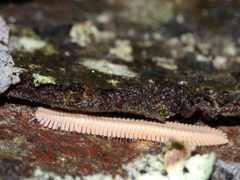
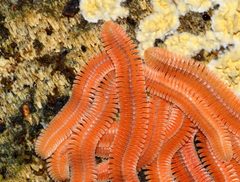
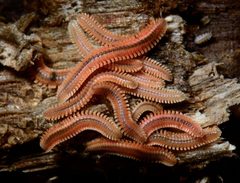
Brachycybe is a of small, eyeless millipedes known for their unusual social and rare paternal care. Males of most coil around and guard clutches until hatching, a behavior virtually unique among . These millipedes form distinctive 'pinwheel' when feeding on fungi, with individuals arranged in circles -inward. The genus originated in western North America approximately 50 million years ago and now occurs in disjunct across North America and East Asia.
Pronunciation
How to pronounce Brachycybe: /brəˈkaɪsiːbi/
These audio files are automatically generated. While they are not always 100% accurate, they are a good starting point.
Identification
All lack entirely. reach approximately 25 mm in length. Body color ranges from orange to tan to pink; B. picta is distinguished by five brown spots. Species are distinguished by subtle features of the collum (first body segment) and paranota (lateral keels), as male are relatively simple and provide few diagnostic characters. The 9th and 10th leg pairs in mature males are modified into gonopods. Integrative approaches combining , molecular data, and are required for accurate species identification due to cryptic diversity.
Images
Habitat
Temperate deciduous forests, specifically in mesic conditions on decaying wood. Found under logs, in leaf litter, and clustered on fungal mats growing on rotting logs. Associated with diverse tree including Liriodendron tulipifera, Magnolia macrophylla, Quercus, Pinus, Acer, Fagus grandifolia, Tsuga, Rhododendron, Carya, Carpinus caroliniana, Asimina triloba, Platanus occidentalis, Prunus serotina, and Juniperus virginiana.
Distribution
Disjunct distribution across North America and East Asia. North American range includes: Pacific coastal region from Oregon to southern California; eastern regions encompassing the southern Appalachian Mountains, Cumberland Plateau, Ozark Mountains, and parts of the Gulf Coastal Plain. Specific distributions: B. lecontii from Virginia to Illinois and Kansas, south to Louisiana and southern Alabama; B. petasata in adjacent parts of North Carolina, Georgia, Alabama, and Tennessee; B. picta and B. producta in northern California; B. nodulosa in central and southern Japan and southern South Korea; B. cooki in Jiangxi Province, China; B. disticha in Taiwan.
Seasonality
Oviposition period for B. lecontii extends from mid-April to late June.
Diet
Primarily fungivorous. Feeds on fungal growth on decaying wood, inserting into fungal tissue. Gut contents contain highly diverse fungal spanning at least 176 across 39 orders and four . Twelve fungal genera comprise a core consistently found across and substrates. Contrary to earlier speculation, wood-decay fungi in the order Polyporales are rare in the core community and some prove lethal in experimental assays.
Life Cycle
lasts 3–4 weeks. Moulting occurs over approximately 10 days without construction of moulting chamber or consumption of shed .
Behavior
Males exhibit paternal care by coiling body around masses and guarding until hatching; eggs become unviable if separated from male. Males will seek out and collect separated eggs, including abandoned eggs of other males, adding them to their own clutch. Forms social colonies with multi-generational . Creates 'pinwheel' formations—stellate aggregations with pointing inward and bodies radiating outward—when feeding on fungi; females are more likely to form these groups. Pinwheel requires presence of fungus and is associated with feeding.
Ecological Role
Fungivore in decaying wood . May facilitate fungal through fecal deposition, with fecal pellets showing enriched fungal diversity compared to substrate. Gut fungi possess functional capacity for cellulose and lignin degradation, potentially aiding digestion of recalcitrant plant material. Chemical defense glands occupying one-third of paranotal volume produce compounds that repel such as ants. diverse fungal biodiversity including undescribed species, representing a 200–300 million-year-old evolutionary association within Colobognatha.
Sources and further reading
- BugGuide
- Wikipedia
- GBIF taxonomy match
- iNaturalist taxon
- NCBI Taxonomy
- Catalogue of Life
- Natural history of the social millipede Brachycybe lecontii Wood, 1864
- Diversity and function of fungi associated with the fungivorous millipede, Brachycybe lecontii
- Diversity and Function of Fungi Associated with the Fungivorous Millipede, Brachycybe lecontii
- Diversity and function of fungi associated with the fungivorous millipede, Brachycybe lecontii
- The Chemistry of the Defensive Secretions of Three Species of Millipedes in the Genus Brachycybe.