
Brachycybe lecontii
Wood, 1864
Feather Millipede
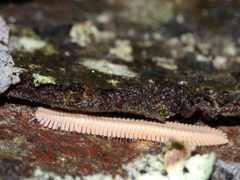
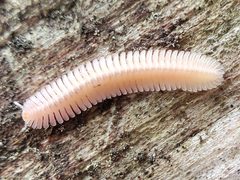
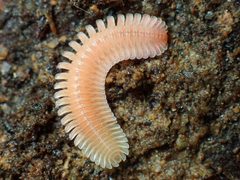
Brachycybe lecontii is a small, eyeless, pink-colored to the eastern United States. It is one of the few known social millipedes, forming multi-generational colonies and distinctive "pinwheel" during feeding. Males exclusively provide paternal care of during a 3–4 week ; egg survival depends entirely on this care. The is obligately fungivorous, feeding on diverse fungi, and possesses specialized cuticular structures possibly adapted for mycophagy.
Pronunciation
How to pronounce Brachycybe lecontii: //ˌbræ.kɪˈsaɪ.bi lɛˈkɒn.taɪ.aɪ//
These audio files are automatically generated. While they are not always 100% accurate, they are a good starting point.
Identification
Distinguished from other millipedes by combination of: complete absence of ; soft, pink body coloration; occurrence in social ; and eastern U.S. distribution. The Brachycybe is the only colobognath genus known to exhibit social . Similar B. nodulosa occurs in western North America and differs in distribution and subtle morphological features. Other pink millipedes in the region lack the social behavior and specialized leg structures.
Images
Appearance
Small, soft-bodied lacking entirely. Body color is pink, with geographic variation in shade. exhibits measurable spectral reflectance properties. Possesses a previously undescribed comb-like structure on the tibia and of the six -most leg pairs. A cuticular structure occurs on the tip of the that may relate to . Large defensive glands occupy approximately one-third of paranotal volume in individuals of stadia II and older.
Habitat
Mesic temperate deciduous forests, specifically on and under decaying logs with fungal growth. Found under logs, in leaf litter, and on decaying wood. Documented from diverse woody substrates including Liriodendron tulipifera, Magnolia macrophylla, Quercus, Pinus taeda, Tsuga, Acer, Fagus grandifolia, Rhododendron, Carya, Carpinus caroliniana, Asimina triloba, Platanus occidentalis, Juniperus virginiana, and Prunus serotina.
Distribution
Eastern United States, with a large, fragmented distribution extending from southern Missouri and West Virginia to eastern Texas and southern Georgia. Documented from 13+ localities across Alabama, Arkansas, North Carolina, Missouri, Tennessee, and Virginia.
Seasonality
Oviposition occurs from mid-April to late June. lasts 3–4 weeks. Active year-round in suitable , with reproductive activity concentrated in spring.
Diet
Obligately fungivorous. Feeds on fungi of the order Polyporales and diverse fungal spanning at least 176 from 39 orders and four . Twelve fungal genera from nine orders form a conserved core community across wood substrates and clades. Gut contents include Mucoromycotan fungi and diverse Ascomycota and Basidiomycota.
Host Associations
- Fungi (diverse community) - food sourceAt least 183 in 40 orders from four ; core includes 12 conserved genera
- Hypocreales (entomopathogenic fungi) - possible mutualismMore common in core fungal but cause little mortality; less susceptible than insect models
- Polyporales (wood decay fungi) - lethal interactionFeeding observed but high mortality in assays; physical overgrowth may be mechanism
Life Cycle
Development includes stadia (instars) with defensive glands appearing only in stadia II and older. Moulting occurs over approximately 10 days without construction of a moulting chamber or consumption of the shed . No subsequent care of juveniles after hatching has been observed; young appear independent immediately after from .
Behavior
Forms stable, persistent multi-generational colonies. Creates distinctive "pinwheel" —stellate-shaped groups with together in a central hub and bodies radiating outward—exclusively in presence of fungi, indicating feeding association. Sociality is subsocial (lacks system), not eusocial. Males actively seek, collect, and ; will adopt abandoned eggs from other males. Combines clutches in some cases, with one male eventually assuming sole care.
Ecological Role
Fungivore contributing to decomposition and nutrient cycling in temperate deciduous forest . diverse fungal biodiversity including several undescribed species. Participates in an ancient 200–300 million-year-old -fungus association characteristic of subterclass Colobognatha. Chemical defense via alkaloid compound (structurally similar to buzonamine) stored in paranotal glands.
Human Relevance
Subject of scientific research due to unusual social and paternal care, rare among millipedes. Serves as a model organism for studying the evolution of sociality and parental care in arthropods. No documented economic importance or pest status.
Similar Taxa
- Brachycybe nodulosaCongeneric western North American ; differs in geographic distribution and subtle morphological features; both share social and paternal care
- Other PlatydesmidaSame order but lack social , pinwheel , and specialized leg structures; typically solitary
- Other pink millipedes (e.g., some Polydesmida)Similar coloration but lack eyelessness, social , and eastern U.S. distribution; typically harder-bodied
More Details
Fungal community complexity
The associated fungal is far more diverse than previously assumed, with wood decay fungi (long speculated as primary food source) notably absent from the core and actually lethal to millipedes, while fungi paradoxically dominate the conserved core community with minimal health effects.
Evolutionary significance
Represents one of the earliest known mycophagous terrestrial lineages and one of only a few groups to evolve social , making it important for understanding of sociality and parental care.
Sources and further reading
- BugGuide
- Wikipedia
- GBIF taxonomy match
- iNaturalist taxon
- NCBI Taxonomy
- Catalogue of Life
- The Festive Tiger Beetle in Southeast Missouri | Beetles In The Bush
- Natural history of the social millipede Brachycybe lecontii Wood, 1864
- Diversity and function of fungi associated with the fungivorous millipede, Brachycybe lecontii
- Diversity and Function of Fungi Associated with the Fungivorous Millipede, Brachycybe lecontii
- Diversity and function of fungi associated with the fungivorous millipede, Brachycybe lecontii