
Andrognathus
Cope, 1869
Species Guides
1- Andrognathus corticarius(Cope's Noodle Millipede)
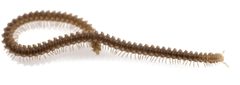
Andrognathus is a of small, thin-bodied millipedes in the order Platydesmida, Andrognathidae. The genus contains three extant —A. corticarius, A. grubbsi, and A. hoffmani—distributed in deciduous forests of eastern North America, New Mexico, and Mexico respectively. A fossil species, A. burmiticus, is known from 99-million-year-old Burmese amber, indicating a formerly broader distribution. These millipedes are euanamorphic, adding segments throughout their lifespan, and exhibit paternal care .
Pronunciation
How to pronounce Andrognathus: //ændroʊˈɡnæθəs//
These audio files are automatically generated. While they are not always 100% accurate, they are a good starting point.
Identification
Members of this are distinguished from other platydesmidans by their small, thin-bodied form with 45–70 body rings and body length of 11–27 mm. They lack the stellate or pinwheel formations characteristic of related genera Brachycybe and Pseudodesmus. Male genitalia show previously unrecognized morphological variation that may indicate cryptic within A. corticarius.
Images
Habitat
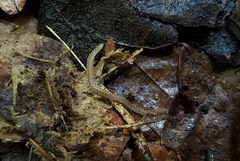
Deciduous forests, specifically within decaying hardwood logs that are beginning to lose bark and soften due to decomposition. Individuals are found beneath bark and inside decaying wood and humus. Occasional records exist from dry under pine logs.
Distribution
Eastern United States (A. corticarius: Florida panhandle north to southern Indiana and Pennsylvania, with records from Ohio); New Mexico (A. grubbsi); Mexico (A. hoffmani: Nuevo León). Fossil evidence from Burmese amber (Myanmar) indicates historical presence in Southeast Asia.
Life Cycle
Euanamorphic development: individuals add leg-pairs and segments throughout their lifespan for an indeterminate period. possess 45–70 body rings.
Behavior
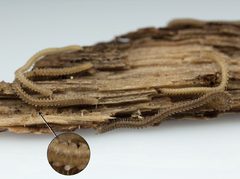
of and juveniles beneath bark of decaying logs; not observed in stellate/pinwheel formations. Burrowing into dead organic matter. Chemical secretions present on ozopores. Paternal care observed: male and female coiled around .
Ecological Role
Decomposer in forest , inhabiting decaying wood in mesic forest .
Similar Taxa
- BrachycybeRelated platydesmidan ; distinguished by stellate/pinwheel formations not seen in Andrognathus
- PseudodesmusRelated platydesmidan ; distinguished by stellate/pinwheel formations not seen in Andrognathus