
Paeromopus
Karsch, 1881
Species Guides
1Paeromopus is a of large cylindrical millipedes to California, United States. The genus contains four , with body lengths ranging from 10 to 16.5 cm, making P. paniculus the longest species in North America. Three species have restricted ranges in the Sierra Nevada mountains, while P. angusticeps has a broad distribution across Northern California and the Central Coast. The genus was established by Ferdinand Karsch in 1881 and belongs to the Paeromopodidae.
Pronunciation
How to pronounce Paeromopus: /paɪˈrɒməpəs/
These audio files are automatically generated. While they are not always 100% accurate, they are a good starting point.
Identification
Distinguished from other large North American millipedes by the combination of: cylindrical body form (not flattened), presence of fine parallel striations on each body segment, and the male's reduced first leg pair. Differs from Spirobolidae (including Spirobolus) by belonging to order Julida rather than Spirobolida. Separated from the related Californiulus by subtle morphological differences in structure and body proportions. The four are distinguished by geographic range and subtle morphological features, with P. angusticeps being the only species found west of the Sierra Nevada crest.
Images
Appearance
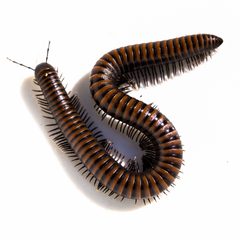
Large cylindrical millipedes measuring 10–16.5 cm in length and up to 8 mm in width, with 68–80 body segments. Body coloration is typically brown to black with bands of light brown or yellow, though some individuals appear dark gray or bluish gray with indistinct banding. The exosurface has fine parallel grooves (striations) on each segment, creating a roughened texture. Legs are relatively long; in males, the first pair of legs is extremely reduced. Ocelli occur in two lateral patches on the , each containing up to 31 ocelli of unequal sizes arranged in rows.
Habitat
Occupies forested in the Sierra Nevada mountains and Coast Ranges of California. P. angusticeps occurs in oak woodlands, mixed evergreen forests, and coastal scrub from sea level to moderate elevations, while the three Sierra Nevada are restricted to montane coniferous forest zones.
Distribution
to California, United States. P. angusticeps ranges from Monterey County on the central coast, north through the Coast Ranges to Humboldt County, and east along the Cascades and Sierra Nevada. P. paniculus, P. evides, and P. variegatus are restricted to isolated localities within the Sierra Nevada mountains.
Ecological Role
Functions as a in California forest , contributing to decomposition of leaf litter and organic matter.
Similar Taxa
- CaliforniulusClosely related paeromopodid also to California; distinguished by and body proportions
- SpirobolusFormerly confused taxonomically with Paeromopus; belongs to different order (Spirobolida) and (Spirobolidae), lacks the fine striations characteristic of Paeromopus
More Details
Taxonomic history
The name Paeromopus was established by Karsch in 1881, though the type P. angusticeps was originally described as Spirobolus angusticeps by Horatio C. Wood in 1864. Chamberlin transferred it to Paeromopus in 1949. Karsch's original species P. lysiopetalinus was later synonymized with P. angusticeps. The most recent species description, P. paniculus, was published in 1997.
Etymology
The suffix -pus in Paeromopus refers to legs; the full meaning of the name was not specified by Karsch.