
Californiulus
Verhoeff, 1938
Species Guides
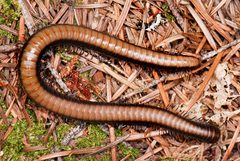
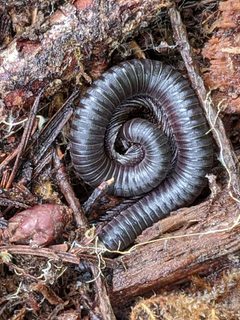
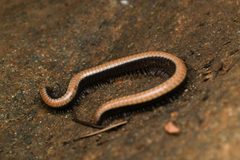
4Californiulus is a of cylindrical millipedes in the Paeromopodidae, containing six restricted to the western United States. range from 5 to 11 cm in length and up to 4.7 mm in width. The genus exhibits two distinct color pattern types: some species display a broad stripe of light brown, orange, or yellow, while others show banding of light brown against a dark gray or black background.
Pronunciation
How to pronounce Californiulus: //ˌkælɨˈfɔrnijʊləs//
These audio files are automatically generated. While they are not always 100% accurate, they are a good starting point.
Identification
Distinguished from other western North American julid millipedes by the combination of large size (up to 11 cm), cylindrical body, and the specific color patterns described. The is to the western United States, which helps separate it from superficially similar eastern genera. -level identification requires examination of .
Images
Appearance
Cylindrical body form typical of julid millipedes. length 5–11 cm, width up to 4.7 mm. Two color pattern types observed: (1) broad stripe of light brown, orange, or yellow running dorsally; (2) banded pattern with light brown against dark gray or black base color.
Habitat
Occurs in a range of environments across western North America, from mesic forests of northern Washington to arid regions including Death Valley, California. One occupies a disjunct range in extreme eastern Oregon to Montana, suggesting for varied moisture regimes.
Distribution
Western United States: from northern Washington south to Death Valley, California. One occurs separately from the main group, ranging from extreme eastern Oregon to Montana.
Ecological Role
As with other large-bodied millipedes, likely contributes to decomposition of plant litter and nutrient cycling in forest and scrubland . Specific ecological functions have not been documented for this .
Similar Taxa
- PaeromopusAlso in Paeromopodidae and western North American; distinguished by structure and subtle differences in color pattern distribution.
- Other Julida generaMany julid millipedes share cylindrical form; Californiulus is distinguished by its western U.S. , large size, and characteristic color patterns.
More Details
Taxonomic history
The was described by Verhoeff in 1938 and has remained relatively stable, containing six recognized .
Disjunct distribution
The occurrence of one from eastern Oregon to Montana, separate from the main western coastal range, suggests either historical range fragmentation or undetected cryptic diversity.