
Lithobius melanops
Newport, 1845
Garden Lithobius, European steppe centipede
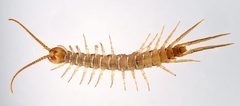
Lithobius melanops is a small stone centipede in the order Lithobiomorpha, native to Europe but introduced to many regions worldwide. measure 11–17 mm in length with a dorsoventrally flattened, body. The is distinguished by a combination of morphological traits including 32–44 antennal articles, 10–13 ocelli with a notably enlarged ocellus, and specific tergite projections. It inhabits dry, open and is a of soil .
Pronunciation
How to pronounce Lithobius melanops: /lɪˈθoʊbiəs ˈmɛləˌnɒps/
These audio files are automatically generated. While they are not always 100% accurate, they are a good starting point.
Identification
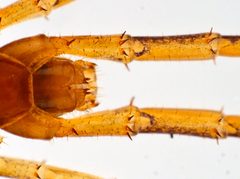
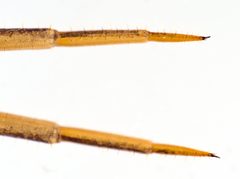
Reliable identification requires possession of all diagnostic features in combination: 32–44 antennal articles, 10–13 ocelli with enlarged ocellus, 2+2 forcipular teeth (rarely 3+3), 3–6 round pores on each hind , backwards projections on tergites 9, 11, and 13, and double claws on the 15th leg. No single trait is sufficient for definitive identification.
Images
Appearance
Body and dorsoventrally flattened, 11–17 mm long and 1.5–2.5 mm wide. Coloration typically pale brown with a darker longitudinal stripe along the midline. with 32–44 articles. Ocelli number 10–13, with the ocellus substantially larger than the others. Forcipular teeth arranged 2+2 (rarely 3+3). Hind bear 3–6 round pores each. Tergites 9, 11, and 13 possess backwards projections. The 15th leg terminates in double claws of unequal size.
Habitat
Dry and open terrestrial including steppes, dry hillsides, bright forests, woodlands, heathlands, gardens, and churchyards. Also occurs in coastal habitats: sand dunes, shingle beaches, and vegetated sea cliffs. Shelters under stones, dead wood, loose bark, on walls, and rock . Occupies environments.
Distribution
Native to Europe, now . Europe: Iceland, Ireland, United Kingdom, Spain, France, Belgium, Netherlands, Luxembourg, Switzerland, Germany, Denmark (including Faroe Islands), Norway, Sweden, Finland, Austria, Czechia, Slovakia, Poland, Hungary, Slovenia, Croatia, Bosnia-Herzegovina, Italy, Romania, Bulgaria, Latvia, Lithuania, Ukraine, Russia. Africa: Morocco, Azores, Madeira, Canary Islands, Saint Helena, South Africa. North America: United States, Canada, Mexico. South America: Ecuador, Brazil, Argentina. Asia: Israel, Asian Russia, Kazakhstan. Oceania: New Zealand.
Seasonality
Active year-round; can be found in all seasons.
Diet
opportunistic . Prey includes earthworms, potworms (Enchytraeidae), small millipedes, springtails (Collembola), spiders, and insect larvae. Occasionally scavenges.
Life Cycle
Hemianamorphic development typical of Lithobiomorpha: juveniles hatch with fewer body segments and leg pairs than , acquiring additional segments and legs through successive until reaching the adult complement of 15 leg pairs. Further molts continue after reaching adult segment number, resulting in increased body size and additional anatomical development.
Behavior
. Kills prey using venom delivered via forcipules. Venom is not medically significant to humans.
Ecological Role
of soil-dwelling ; contributes to regulation of of earthworms, small arthropods, and other litter fauna. Occasional scavenging may contribute to nutrient cycling.
Human Relevance
Occasionally encountered in gardens and . Venom not medically significant to humans. No documented economic importance.
Similar Taxa
- Other Lithobius speciesMany Lithobius share general body plan and preferences; L. melanops is distinguished only by the specific combination of antennal articles, ocelli number and arrangement, forcipular , coxal pores, tergite projections, and 15th leg claw structure.