
Macrostemum
Kolenati, 1859
Glossy Wing Sedges
Species Guides
2- Macrostemum carolina
- Macrostemum zebratum(Zebra Caddisfly)
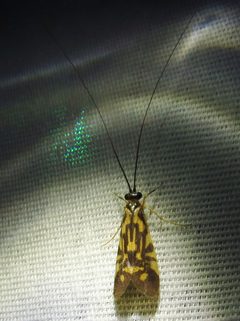
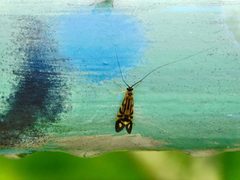
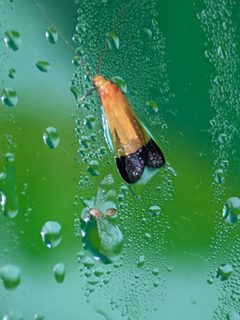
Macrostemum is a of net-spinning caddisflies in the Hydropsychidae, comprising at least 90 described . are recognized by distinctive dark and light contrasting wing patterns. Larvae construct silken retreats with capture nets to filter fine particulate organic matter from flowing water. The genus is particularly diverse in the Neotropical region, with species documented across Africa, Asia, Madagascar, and the Americas.
Pronunciation
How to pronounce Macrostemum: /ˌmækrəʊˈstiːməm/
These audio files are automatically generated. While they are not always 100% accurate, they are a good starting point.
Identification
distinguished by strongly marked dark and clear wing patterns; larvae identified by prosternal plate and stridulatory ridge patterns (variable among ). Macrostemum brasiliense exhibits characteristic wing and body patterns with documented melanic female variation. Larvae of M. floridum average 25 mm in length with width of 2.3 mm in final instar.
Images
Habitat
Flowing water including streams and rivers; larvae require high current velocity environments. M. alienum collected below dam spillways with high water current during rainy season; M. brasiliense primarily in Atlantic Rainforest streams of southeastern Brazil; M. floridum in tropical streams of southern Thailand.
Distribution
: Neotropical region (15+ valid , Brazil), Afrotropical region (West Africa, Nigeria, Sudan, Ghana, Ivory Coast, Madagascar eastern slope), Oriental region (Thailand, Japan), Nearctic region.
Diet
Larvae are collecting filterers; gut content analysis of M. floridum showed main food items as diatoms, green , and blue-green algae.
Life Cycle
Larvae undergo five instars; capsule width measurements provided for all instars in M. floridum. Metamorphotype method used to associate stages with .
Behavior
Larvae construct fixed retreats with silken capture nets. M. carolina exhibits retreat with three distinct retreat morphs (silken tube entrance, ≈180° silken backstop, flush entrance) representing alternative behavioral phenotypes within a single panmictic rather than genetic differentiation. M. brasiliense exhibits described courtship and copulation.
Ecological Role
Filter-feeding larvae process fine particulate organic matter in lotic .
Sources and further reading
- BugGuide
- Wikipedia
- GBIF taxonomy match
- iNaturalist taxon
- NCBI Taxonomy
- Catalogue of Life
- Un nouveau Macrostemum Kolenati, 1859, d’Afrique occidentale (Trichoptera, Hydropsychidae)
- Notes sur quelques Macrostemum Kolenati, 1859, du versant oriental malgache (Trichoptera, Hydropsychidae)
- First record of Macrostemum alienum Ulmer 1907 (Trichoptera: Hydropsychidae: Macronematinae) from Ile-Ife, Southwestern Nigeria, West Africa
- Distribution and Occurrence of Four Caddisfly Species in Genus Macrostemum along Nan River in Nan Province, Thailand
- Description of female genitalia, additional morphological variations, and courtship behavior and copulation of Macrostemum brasiliense (Fischer 1970) (Trichoptera: Hydropsychidae)
- The genus Macrostemum Kolenati 1859 (Trichoptera: Hydropsychidae) in the Neotropical Region: Description of two new species, taxonomic notes, distributional records and key to males
- Description of the larva of Macrostemum floridum (Navás 1929) (Trichoptera: Hydropsychidae) and its feeding habits in Kaengkrung National Park, southern Thailand.
- Molecular genetic markers provide no evidence for reproductive isolation among retreat building phenotypes of the net‐spinning caddisfly Macrostemumcarolina
- Downstream Distribution and Annual Changes in Densities of Net-Spinning Trichoptera (Hydropsychidae and Stenopsychidae) in the Yoshino River, Shikoku, Japan, with Special Reference to the Colonization of Macrostemum radiatum McLachlan (Trichoptera: Hydropsycheidae).