
Macrostemum zebratum
(Hagen, 1861)
Zebra Caddisfly
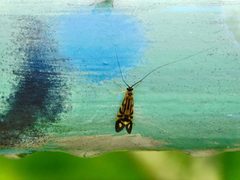
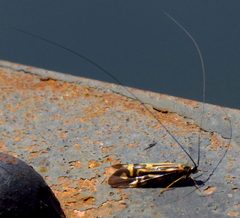
Macrostemum zebratum, commonly known as the zebra caddisfly, is a of netspinning caddisfly in the Hydropsychidae. It is a medium to large caddisfly recognized by its distinctive patterned wings. As a member of the Hydropsychidae, it constructs silk capture nets in flowing water to filter food particles.

Pronunciation
How to pronounce Macrostemum zebratum: /mækrəˈstiːməm zɛˈbrætəm/
These audio files are automatically generated. While they are not always 100% accurate, they are a good starting point.
Identification
Distinguished from other Hydropsychidae by the bold black and white wing pattern; most similar in the have plain or differently patterned wings. The Macrostemum contains some of the largest hydropsychids, and M. zebratum can be separated from by the specific zebra-striped wing pattern and North American distribution.
Images
Appearance
have distinctive black and white patterned wings that give the its . The wings are relatively broad with a mottled or banded appearance. Body size is medium to large for the . Larvae construct portable cases and have well-developed thoracic legs adapted for clinging to substrates in fast-flowing water.
Habitat
Flowing freshwater including streams and rivers. Larvae require clean, well-oxygenated water with moderate to fast current for net construction and feeding.
Distribution
North America; specifically recorded from the Nearctic region including the United States (e.g., Vermont) and presumably Canada. The exact range within North America is not fully detailed in available sources.
Diet
Larvae are filter-feeders that capture drifting organic particles, including , detritus, and small , using silk nets constructed across current.
Life Cycle
Complete with , larva, pupa, and stages. Larvae are aquatic and construct silk capture nets. occurs within a modified case in the aquatic environment. Adults are terrestrial and short-lived, primarily for .
Behavior
Larvae are filter-feeders that maintain and repair their capture nets. They exhibit territorial around net sites. are and attracted to light.
Ecological Role
Larvae function as collector-filterers in stream , processing fine particulate organic matter and transferring energy to higher . They serve as prey for fish and other aquatic . provide food for terrestrial predators such as birds and bats.
Human Relevance
Used as bioindicators of water quality due to sensitivity to pollution and degradation. occasionally attracted to lights near water bodies. No direct economic importance.
Similar Taxa
- Other Macrostemum speciesLack bold zebra-striped wing pattern; may have plainer or differently marked wings
- Other HydropsychidaeGenerally smaller with unpatterned or uniformly colored wings; lack distinctive contrasting wing markings
More Details
Net-spinning behavior
As a hydropsychid, larvae produce silk from modified salivary glands to construct funnel-shaped or trumpet-shaped nets that capture drifting food particles in current.
Taxonomic note
The Macronematinae includes some of the largest and most visually distinctive hydropsychid .