
Macrostemum carolina
(Banks, 1909)
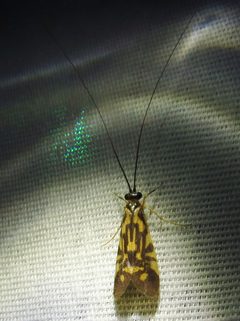
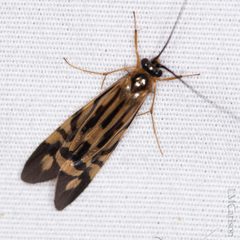
Macrostemum carolina is a net-spinning caddisfly in the Hydropsychidae. Larvae construct silken catchnets within protective retreats to filter food from flowing water. Multiple retreat-building phenotypes exist within this , including retreats with water entrance holes at the end of silken tubes, with 180° silken backstops, or flush with the retreat top. Molecular genetic analysis confirms these phenotypes represent a single panmictic rather than cryptic species.
Pronunciation
How to pronounce Macrostemum carolina: /ˌmæk.roʊˈstiː.məm ˌkæ.rəˈlaɪ.nə/
These audio files are automatically generated. While they are not always 100% accurate, they are a good starting point.
Identification
Larvae construct silken catchnets and retreats in flowing water; possess typical hydropsychid features including hairy wings and reduced mouthparts. Retreat (three distinct morphs) is not diagnostic of separate or within this .
Images
Habitat
Streams and rivers with flowing water where larvae can construct filter-feeding nets and retreats. Larval stage is fully aquatic.
Distribution
North America; specifically documented from the Savannah River system.
Diet
Larvae are filter-feeders, capturing suspended organic matter and small particles in silken nets.
Life Cycle
Holometabolous with aquatic larval stage, pupal stage in retreat or chamber, and terrestrial stage. Specific timing of and voltinism not documented.
Behavior
Larvae exhibit polymorphic retreat-building , constructing one of three retreat types: silken tube with terminal entrance, 180° silken backstop, or flush-topped retreat. All three morphs co-occur and interbreed freely. Net-spinning behavior used for passive filter-feeding.
Ecological Role
Filter-feeder in stream ; contributes to nutrient cycling and serves as prey for aquatic . Part of the macroinvertebrate used as bioindicators of water quality.
Similar Taxa
- Other HydropsychidaeShare net-spinning larval ; distinguished by specific retreat architecture and genetic identity where tested.
- Other Macrostemum speciesCongeneric may overlap in distribution; require morphological examination of or molecular markers for definitive identification.
More Details
Retreat Polymorphism
The three retreat phenotypes in M. carolina were initially suspected to represent cryptic or genetically isolated . at three loci (Gpi, Mpi, Pgm) and mitochondrial haplotype analysis found no significant genetic differentiation among morphs, confirming they represent behavioral plasticity or Mendelian within a single interbreeding population.
Sources and further reading
- BugGuide
- Wikipedia
- GBIF taxonomy match
- iNaturalist taxon
- NCBI Taxonomy
- Catalogue of Life
- Carolina Grasshopper
- Death of a lanternfly, Part 2: Lanternfly on the Thanksgiving menu for a gal called Carolina – Carolina mantis, Stagmomantis carolina — Bug of the Week
- Surviving winter, Part III: Egg cases of the Praying mantis, Mantis religiosa, Chinese mantis, Tenodera sinensis, and Carolina mantis, Stagmomantis carolina — Bug of the Week
- Decorations on the Christmas tree: Egg cases of the European mantis, Mantis religiosa, Chinese mantis, Tenodera sinensis, and Carolina mantis, Stagmomantis carolina — Bug of the Week
- Exciting But Dreadful: New Invasive Forest Pest Arrives in South Carolina
- Decorations on the Christmas tree: Egg cases of the European mantis, Mantis religiosa, Chinese mantis, Tenodera sinensis, and Carolina mantis, Stagmomantis carolina — Bug of the Week
- Molecular genetic markers provide no evidence for reproductive isolation among retreat building phenotypes of the net‐spinning caddisfly Macrostemumcarolina