
Selenothrips
Karny, 1911
red-banded thrips (for S. rubrocinctus)
Species Guides
1- Selenothrips rubrocinctus(redbanded thrips)
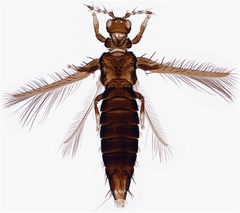
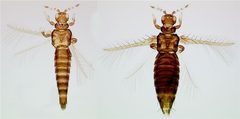
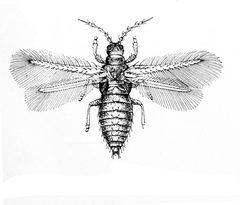
Selenothrips is a of in the Thripidae, established by Heinrich Hugo Karny in 1911. The genus contains at least two described : S. rubrocinctus (Giard, 1901), commonly known as the red-banded thrips or cacao thrips, and S. glabratus Priesner, 1927. S. rubrocinctus is a pest with broad tropical and subtropical distribution, known to attack cacao, cashew, mango, avocado, and other crops. Research on this species has focused on its feeding in relation to plant water-stress and availability.
Pronunciation
How to pronounce Selenothrips: //sɛˈliːnoʊˌθrɪps//
These audio files are automatically generated. While they are not always 100% accurate, they are a good starting point.
Identification
The Selenothrips belongs to the Panchaetothripinae. -level identification requires examination of morphological characters not detailed in available sources. S. rubrocinctus is distinguished by the red banding pattern referenced in its , though specific diagnostic features are not provided in the available literature.
Images
Habitat
Tropical and subtropical regions. Specific microhabitat requirements are not documented for the as a whole. S. rubrocinctus has been observed in cacao plantations, cashew orchards, mango groves, and urban ornamental settings on forest .
Distribution
Tropical and subtropical regions globally. Documented occurrences include: Asia (China, Taiwan, India, Malaya, Philippines); Africa (Congo, Fernando Po, Ghana, Ivory Coast, Nigeria, Principe, Republic of Congo, Sao Thomé, Sierra Leone, Tanzania, Uganda, Zanzibar); Australasia and Pacific Islands (Hawaii, Mariana Islands, New Caledonia, Papua New Guinea, Solomon Islands, Wallis Island); North America (USA); Central America and West Indies ( Rica, Honduras, Panama, West Indies); South America (Brazil, British Guiana, Ecuador, Peru, Surinam, Venezuela). First European field record from northern Italy (2021).
Host Associations
- cacao - pestprimary for S. rubrocinctus
- cashew - pestS. rubrocinctus peak during dry season on this in Trinidad
- mango - pest association
- avocado - pest association
- guava - pest association
- rose - laboratory S. rubrocinctus can be reared on rose leaflets in laboratory conditions
- Liquidambar styraciflua - first European record from northern Italy
- Carpinus betulus - first European record from northern Italy
Human Relevance
S. rubrocinctus is an agricultural pest of economic significance, particularly affecting cacao production. The has been the subject of extensive research on plant-insect interactions related to water-stress and nutrient availability. Laboratory rearing methods have been developed for biological study.
Sources and further reading
- BugGuide
- Wikipedia
- GBIF taxonomy match
- iNaturalist taxon
- NCBI Taxonomy
- Catalogue of Life
- Selenothrips rubrocinctus . [Distribution map].
- Breeding technique of Selenothrips rubrocinctus (Giard, 1901) (Thysanoptera: Thripidae) on roses leaflets
- Selenothrips Rubrocinctus(Giard) and the Floral Biology of Cashew in Tanganyika
- First Field Record of the Tropical Red-Banded Thrips Selenothrips rubrocinctus (Thripidae: Panchaetothripinae) in Europe
- Nutritional factors associated with seasonal population increase of cacao thrips,Selenothrips rubrocinctus(Giard) (Thysanoptera), on cashew, Anacardium occidentale
- The influence of environmental stress on the cacao tree in predetermining the feeding sites of cacao thrips, Selenothrips rubrocinctus (Giard), on leaves and pods