
Caliothrips
Daniel, 1904
bean thrips, banded thrips
Species Guides
1- Caliothrips cinctipennis(bean thrips)
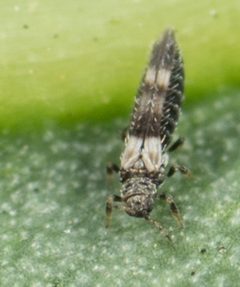
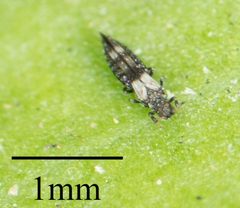
Caliothrips is a of in the Thripidae, Panchaetothripinae, established by Daniel in 1904. in this genus are phytophagous, typically associated with plant leaves, and several are recognized as agricultural pests. The genus includes notable species such as C. phaseoli (bean thrips) and C. fasciatus (North American bean thrips), which feed on legumes and other crops. are characterized by distinct wing banding patterns and small size (~1 mm). Some species have been intercepted in international trade, particularly in navel oranges, triggering concerns.
Pronunciation
How to pronounce Caliothrips: //kæliˈoʊθrɪps//
These audio files are automatically generated. While they are not always 100% accurate, they are a good starting point.
Identification
Members of Caliothrips can be distinguished from the superficially similar predatory Aeolothrips ( Aeolothripidae) by wing banding patterns and family-level characters. In C. phaseoli, the forewings display humeral and post- white bands on a dark background, whereas Aeolothrips fasciatus shows humeral, median, and white bands. Caliothrips possess the single characteristic of Thripidae, used for rasping plant tissue. The genus is placed in Panchaetothripinae based on antennal and wing venation features. Species-level identification requires examination of subtle differences in abdominal sculpturing and wing pattern details.
Images
Habitat
are associated with leaves of plants, particularly in agricultural and natural vegetation settings. In crop systems, they occupy the lower, protected leaf surfaces of plants such as soybean, beans, onion, and various legumes. The has been recorded from and crops, urban ornamentals, and native flora.
Distribution
The occurs in the Americas, with records from North America (USA, California; Mexico), Central America (Panama), and South America (Argentina, Brazil). C. fasciatus is native to western North America. C. phaseoli is widespread in North, Central, and South America. Some have been proposed as distinct (e.g., C. brasiliensis for South American populations of C. phaseoli). Despite regular interception in exported navel oranges, established populations have not been detected outside the Americas.
Diet
Phytophagous; feeds on plant tissues through rasping-sucking mouthparts. Documented include legumes (Fabaceae: soybean, beans), onion (Allium cepa, Amaryllidaceae), Solanum dulcamara (Solanaceae), cotton, strawberry, and various economic plants. Feeding causes lacerations, spots, and leaf drying.
Host Associations
- Glycine max - pest ofsoybean, major in Argentina
- Allium cepa - pest ofonion, first record in Panama 2020-2021
- Phaseolus vulgaris - pest ofcommon bean
- Solanum dulcamara - bittersweet nightshade
- Gossypium - pest ofcotton
- Fragaria - pest ofstrawberry
Life Cycle
Development includes , two larval instars, propupa, pupa, and stages—a pattern intermediate between incomplete and complete . First- and second-instar larvae feed actively; third- and fourth-instars (propupa and pupa) are quiescent, non-feeding stages. Under laboratory conditions, development from egg to adult is temperature-dependent, with thermal thresholds estimated at minimum ~0-6.5°C, optimum ~31-32.5°C, and maximum ~35-38°C. accumulation for complete development approximately 370-385. In field in Panama, stages comprised 46% of captured specimens, indicating active on plants.
Behavior
aggregate in protected locations on plants, particularly lower leaf surfaces. In C. phaseoli, specific sensitivity to ultraviolet-B radiation (290-330 nm) has been demonstrated; the contains a fluorescent internal filter in most that blocks longer UV wavelengths, enabling specialized UV-B detection. Adults of C. fasciatus overwinter in the navels of navel oranges, facilitating accidental transport in international trade. Virgin females of C. fasciatus do not produce offspring when isolated individually, but will produce sons in the presence of other virgin females.
Ecological Role
Primary consumers of plant tissues; function as agricultural pests causing direct feeding damage and, through oviposition, additional plant injury. In crop , they serve as prey for predatory insects including ladybird beetles (e.g., Eriopis connexa in Argentine soybean fields). surges have been associated with dry conditions. The contributes to background diversity in agricultural and natural systems, with survey work in Australia documenting related but failing to find established C. fasciatus populations.
Human Relevance
Several are economically significant agricultural pests. C. phaseoli is a pest of soybean in South America and has been recently recorded damaging onion in Panama. C. fasciatus is a pest for countries importing California navel oranges due to in fruit navels; this has necessitated and cold storage protocols. Control is problematic due to short times (approximately 2 weeks from to egg), preference for protected feeding locations, and limited registered for some crops. The has been subject to extensive survey and monitoring efforts to prevent establishment.
Similar Taxa
- AeolothripsPredatory in Aeolothripidae with similar black-and-white banded wing patterns; distinguished by family-level characters (antennal structure, number), wing banding details, and predatory versus phytophagous habits
- FrankliniellaAnother in Thripidae with some banded ; distinguished by abdominal and wing pattern details, and by ecological associations
- Echinothrips americanusPoinsettia thrips with white wing banding; distinguished by having a distinct white band only at the wing base versus the humeral and post- bands of Caliothrips
More Details
Taxonomic uncertainty
There is disagreement regarding boundaries within Caliothrips. Some authorities recognize South American of C. phaseoli as distinct species C. brasiliensis (or C. braziliensis) based on solid dark versus medially lightened elytral bands. C. phaseoli has also been treated as a synonym of C. fasciatus in some literature, though morphological differences in abdominal sculpturing have been noted. C. marginipennis has been synonymized with C. punctipennis, and C. fasciatus was withdrawn from the Brazilian fauna list.
Invasion biology
Despite more than 120 years of regular interception in exported navel oranges and substantial pressure, C. fasciatus has failed to establish outside North America. The cold accumulation hypothesis suggests that low storage temperatures during transit (2.78°C for 18-24 days) cause high mortality and compromised in survivors. Genetic studies reveal phylogeographic structure within C. fasciatus, with potentially two cryptic (forms A and B) and outbreeding depression between geographically isolated .
Sensory biology
C. phaseoli possesses a specialized visual system for detecting solar UV-B radiation, achieved through a standard UV-A photoreceptor combined with a sharp cut-off internal filter in the . This is rare among insects and represents an for detecting a narrow, low-abundance portion of the solar spectrum.
Sources and further reading
- BugGuide
- Wikipedia
- GBIF taxonomy match
- iNaturalist taxon
- NCBI Taxonomy
- Catalogue of Life
- Thripidae | Beetles In The Bush
- Eriopis connexa on soybean in Argentina | Beetles In The Bush
- ID Challenge #6 | Beetles In The Bush
- Reporte de Caliothrips phaseoli (Hood) (Thysanoptera: Thripidae: Panchaeothripinae) en cebolla en Panamá Report of Caliothrips phaseoli (Hood) (Thysanoptera: Thripidae: Panchaeothripinae) in onion in Panama
- Bean Thrips Caliothrips fasciatus (Pergande, 1895) (Insecta: Thysanoptera: Thripidae)
- The Panchaetothripinae (Thysanoptera, Thripidae) of Brazil, with one new Caliothrips species
- Life cycle and reproduction of Caliothrips phaseoli (Thysanoptera: Thripidae) on Fabaceae and Solanaceae (Plantae) in laboratory conditions
- Phylogeographic structure, outbreeding depression, and reluctant virgin oviposition in the bean thrips,Caliothrips fasciatus(Pergande) (Thysanoptera: Thripidae), in California
- Effects of Temperature on the Developmental and Reproductive Biology of North American Bean Thrips, Caliothrips fasciatus (Pergande) (Thysanoptera: Thripidae: Panchaetothripinae)
- Populations of North American bean thrips, Caliothrips fasciatus (Pergande) (Thysanoptera: Thripidae: Panchaetothripinae) not detected in Australia
- Phytophagy and predatory behavior of Caliothrips phaseoli (Thysanoptera: Thripidae) on bean foliage discs with Tetranychus merganser (Acari: Tetranychidae) eggs
- New Host Records forCaliothrips striatus(Thysanoptera: Thripidae) onMagnoliaspp. with the Description of the Second Instar
- A look into the invisible: ultraviolet-B sensitivity in an insect (Caliothrips phaseoli) revealed through a behavioural action spectrum