
Acroneuria
Pictet, 1841
common stoneflies
Species Guides
5- Acroneuria abnormis(Common Stone)
- Acroneuria arenosa(Eastern Stone)
- Acroneuria carolinensis(Carolina Stone)
- Acroneuria evoluta(Constricted Stone)
- Acroneuria lycorias(Boreal Stonefly)
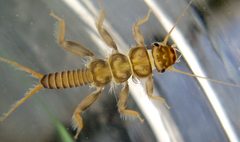
Acroneuria is a of large-bodied stoneflies in the Perlidae, containing more than 30 described distributed across North America and Asia. Nymphs are predatory and inhabit streams and rivers, where they serve as important bioindicators of water quality. are known for distinctive , including arboreal emergence in some species. Several species in the genus are experiencing range contractions and declines due to degradation and climate change.

Pronunciation
How to pronounce Acroneuria: //ˌækroʊˈnjʊriə//
These audio files are automatically generated. While they are not always 100% accurate, they are a good starting point.
Identification
Acroneuria are diagnosed by wing pattern, aedeagal structure, and shape of the female subgenital plate. The is characterized by large body size relative to other perlid genera. Species-level identification requires examination of male genitalia and female subgenital plate .
Images
Habitat
Nymphs inhabit lotic freshwater systems including streams and rivers. Some exhibit arboreal in coniferous forest .
Distribution
North America (including Midwest USA: Illinois, Indiana, Iowa, Michigan, Minnesota, Ohio, Wisconsin; West Virginia; California; northern Wisconsin; northern Michigan) and Asia (central Vietnam, China including Hainan and South-central regions).
Diet
Nymphs are predatory. Specific prey items are not documented in available sources.
Life Cycle
Multivoltine have been reported for some . Nymphs emerge at heights up to 12m on tree branches in arboreal . Post-, climb upward along tree stems to heights up to 22m.
Behavior
Nymphs exhibit behavioral responses to exposure including methoxychlor and fenitrothion. show strong preference for sites at the underside or base of branches. Post-emergence climbing to heights represents the greatest documented heights for any Plecopteran .
Ecological Role
Predatory nymphs function as macroinvertebrate in stream . The serves as a bioindicator of water quality, with impaired associated with aluminum in neutral pH surface waters.
Human Relevance
Used as bioindicators for water quality assessment and environmental . are increasingly imperiled due to human disturbance. Subject of toxicological research examining effects on aquatic .
Similar Taxa
- CalineuriaAcroneuria (Calineuria) californica was historically classified under Acroneuria but has been separated; similar large-bodied perlid
- Other Perlidae generaAcroneuria distinguished by specific wing patterns and genitalic structures; other perlids generally smaller-bodied or with different
More Details
Conservation Status
Regional faunal assessments indicate increasing imperilment from human disturbance and climate change. Large-bodied perlid stoneflies with multivoltine are among the most at risk for regional extirpation. distribution modeling shows suitable losses greatest for A. abnormis and A. internata.
Research Importance
A. lycorias has been extensively studied for production and growth comparisons between hard- and soft-water streams, with production 5.0 times greater in hard-water . Growth rates are influenced more by indirect physical, biological, or habitat factors than by streamwater cation concentrations.
Sources and further reading
- BugGuide
- Wikipedia
- GBIF taxonomy match
- iNaturalist taxon
- NCBI Taxonomy
- Catalogue of Life
- New species of Acroneuria (Plecoptera: Perlidae) from central Vietnam
- Behavioural responses of stream-dwelling Acroneuria lycorias (Ins., Plecopt.) larvae to methoxychlor and fenitrothion
- Acroneuria lycorias (Boreal Stonefly, Plecoptera: Perlidae) Emergence Behaviors Discovered in Pinus strobus Canopy
- Using distribution models to identify range shifts of four Acroneuria Pictet, 1841 (Plecoptera: Perlidae) species in the Midwest USA
- Aspects of the Life History and Growth of Acroneuria (Calineuria) californica in a Sierra Foothill Stream1
- A comparison of Acroneuria lycorias (Plecoptera) production and growth in northern Michigan hard‐ and soft‐water streams
- Life History and Ecology of Acroneuria Carolinensis (Banks) in Panther Creek, Nicholas County, West Virginia (Plecoptera: Perlidae)
- Impaired Acroneuria sp. (Plecoptera, Perlidae) Populations Associated with Aluminum Contamination in Neutral pH Surface Waters