
Anisomorpha
Gray, 1835
two-striped walkingsticks, twostriped walkingsticks
Species Guides
2- Anisomorpha buprestoides(Southern Two-striped Walkingstick)
- Anisomorpha ferruginea(Northern Two-striped Walkingstick)
Anisomorpha is a of large wingless stick insects (Phasmida) known for their potent chemical defense. possess paired metathoracic glands that discharge an irritating secretion capable of causing intense burning pain and temporary blindness in , including humans. Females are substantially larger than males, with some individuals reaching nearly four inches in length. The genus contains four accepted distributed across the southeastern United States, Central America, and northern South America.

Pronunciation
How to pronounce Anisomorpha: //ˌænɪsoʊˈmɔrfə//
These audio files are automatically generated. While they are not always 100% accurate, they are a good starting point.
Identification
Distinguished from other North American walking sticks by the combination of large size (females to ~100mm), winglessness, and presence of two longitudinal pale stripes. The metathoracic gland openings behind the are diagnostic for the . Females are readily identified by their massive size relative to males, which often ride on their backs during mating. The defensive secretion, when discharged, produces a distinctive chemical odor. Similar large phasmids like Megaphasma denticrus lack the bold striping and chemical defense glands.
Images
Appearance
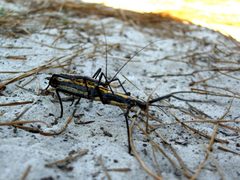
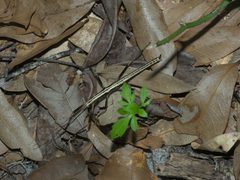
Large, elongate walking sticks with cylindrical bodies. are wingless. Females are markedly larger than males in both length and width. Coloration typically includes contrasting stripes or bands—most notably two pale longitudinal stripes running along the dark body in A. buprestoides. Males of related may display bright aposematic coloration including scarlet bands on black backgrounds. The bears paired gland openings just behind the , visible as small pores above the front legs.
Habitat
Found in wooded and shrubby including oak forests, scrublands, and suburban plantings. Associated with plants including crepe myrtle, roses, oaks, and rosemary. Post-hurricane disturbance may trigger increased surface activity.
Distribution
Southeastern United States (Florida, Georgia, and adjacent states), throughout mainland Central America, and northern South America. Records include the Dominican Republic and Venezuela.
Seasonality
Autumn is the peak season for mating pair formation and activity. Adults have been observed in post-hurricane conditions in Florida during late summer.
Diet
Herbivorous, feeding on leaves of woody shrubs and trees including crepe myrtle (Lagerstroemia), roses (Rosa), oaks (Quercus), and rosemary (Salvia rosmarinus).
Life Cycle
with and nymphal stages. Females likely produce more eggs than smaller females due to size-dependent . Females may add an extra instar relative to males, contributing to size dimorphism. Detailed chronology is not well documented.
Behavior
Forms of up to 20 individuals, often mixed-sex groups. When disturbed, discharges a noxious secretion from metathoracic glands that is highly irritating to vertebrate and mucous . (death feigning) observed as secondary defense. Males engage in , actively searching for females; prolonged copulations occur with males frequently riding on females' backs. Rapid male development may provide mating advantage through earlier maturation.
Ecological Role
Herbivore consuming plant foliage; chemical defense suggests aposematic role in education. Aggregative may provide enhanced predator detection.
Human Relevance
Defensive secretion poses medical hazard: direct contact with causes excruciating pain described as comparable to molten lead and can produce temporary blindness. Handling should be avoided, particularly near the . No significant agricultural pest status documented, though feeding on ornamental plants like roses and crepe myrtle occurs.
Similar Taxa
- Megaphasma denticrusSimilarly large North American stick, but lacks bold striping, has different body proportions, and possesses no chemical defense glands
- DiapheromeraCommon North American stick ; much smaller, more slender, cryptically colored without stripes, and lacks defensive secretions
- Agathemera elegansRelated South American phasmatid with similar chemical defense and aposematic coloration, but geographically separated and with different color patterns (scarlet bands on black in males)
More Details
Sexual size dimorphism mechanism
Females achieve larger size through additional molting instars and extended growth periods compared to males. This trade-off between size and development time may be balanced by male strategy, where rapid maturation provides first-mover advantage in locating mates.
Chemical defense composition
Related A. buprestoides produces anisomorphal, a monoterpene dialdehyde, as the primary defensive compound. The secretion is actively aimed at rather than passively released.
Sources and further reading
- BugGuide
- Wikipedia
- GBIF taxonomy match
- iNaturalist taxon
- NCBI Taxonomy
- Catalogue of Life
- Destination Hutchison Island, Florida: a visit with the Twostriped walkingstick, 'Anisomorpha buprestoides' — Bug of the Week
- Big mamma - Twostriped walkingstick, Anisomorpha buprestoides — Bug of the Week
- Size does matter: Twostriped walkingstick, Anisomorpha buprestoides — Bug of the Week
- Anisomorpha-spp-1150127-PPT - Entomology Today
- Archive — Bug of the Week
- Chilean Chinchemolles - The elegant phasmatid, Agathemera elegans — Bug of the Week
- Behavioral Observations of the Walking Stick, Anisomorpha buprestoides (Phasmatodea: Phasmatidae)
- Life history notes on the Large Yellow Grass-dart, Taractrocera anisomorpha
- BEHAVIORAL ACTIVITY OF ANISOMORPHA BUPRESTOIDES POSSIBLY ASSOCIATED WITH HURRICANE CHARLEY (PHASMATODEA: PHASMATIDAE)
- Fig. 2. Anisomorpha blood serum of the patient K. in the samples: a (sample 1) — merge isotropic granular microspherulites with microspherulites (arrow); b (sample 2) — the scattering of small granules (raw microporosity), some of which are associated with microspherulites without damaging its structure; in (sample 3) — an anomalous impregnation of microspheroidal and their fragments in microspherules (arrow), severe destruction of macroporosity. Microscopy in polarized light ×200