
Anisomorpha ferruginea
(Palisot de Beauvois, 1805)
Northern Two-striped Walkingstick, Dark Walkingstick, Prairie Alligator
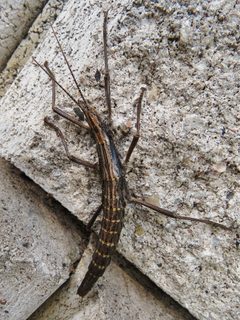
A large, sexually dimorphic walkingstick native to North America, recognized by two longitudinal pale stripes running the length of its dark brown to black body. Females are substantially larger than males. The possesses chemical defense glands behind the that can spray a noxious terpene dialdehyde mist when threatened. Active primarily in autumn when mating pairs are most frequently observed.
Pronunciation
How to pronounce Anisomorpha ferruginea: //ˌænɪˈsɒmfə ˌfɛrəˈdʒɪniə//
These audio files are automatically generated. While they are not always 100% accurate, they are a good starting point.
Identification
Distinguished from other North American walkingsticks by the combination of large size, two bold longitudinal pale stripes on dark background, and presence of defensive spray glands. Differs from Anisomorpha buprestoides (southern two-striped walkingstick) by geographic range—A. ferruginea occurs in the northern and central United States while A. buprestoides is restricted to the southeastern coastal plain. The two may overlap in the southern portion of A. ferruginea's range. No other North American walkingsticks combine this striped pattern with such large body size.
Images
Habitat
Open woodlands, forest edges, prairies, and suburban areas with woody vegetation. Associated with plants including oaks, roses, crepe myrtle, and rosemary. Often found in areas with sufficient vegetation to support feeding and provide mating opportunities.
Distribution
North America: United States from Delaware south to Florida, west to Texas, Oklahoma, and Nebraska, and north to Illinois, Indiana, Kentucky, Pennsylvania, and Virginia. Records from Nebraska considered doubtful.
Seasonality
Autumn peak activity with mating pairs most abundant during this season. present during warmer months; precise varies across broad geographic range.
Diet
Folivorous; feeds on leaves of various woody plants including oaks (Quercus), roses (Rosa), crepe myrtle (Lagerstroemia), and rosemary (Salvia rosmarinus).
Host Associations
- Quercus - food plantoak
- Rosa - food plantroses
- Lagerstroemia - food plantcrepe myrtle
- Salvia rosmarinus - food plantrosemary
Life Cycle
with , nymph, and stages. Females likely deposit eggs in soil or leaf litter. Nymphs undergo multiple ; females may add an extra instar compared to males, contributing to size dimorphism. Adults emerge in summer to autumn. Detailed poorly documented.
Behavior
When threatened, discharges a defensive chemical spray from glands located behind the . The secretion contains terpene dialdehydes and can cause severe pain if contacted, particularly to . Males actively seek females and may remain mounted on female's back for extended periods. Generally slow-moving, relying on when undisturbed.
Ecological Role
Herbivore that consumes leaves of various woody plants. Serves as prey for vertebrate including birds and small mammals, though chemical defense likely reduces pressure. Specific ecological relationships beyond herbivory not well documented.
Human Relevance
Occasional nuisance in gardens when feeding on ornamental plants including roses and crepe myrtle. Defensive spray can cause significant pain and temporary vision impairment if directed at ; handling requires caution. Not considered economically important pest. Sometimes encountered during autumn outdoor activities.
Similar Taxa
- Anisomorpha buprestoidesSouthern two-striped walkingstick with similar striped pattern but restricted to southeastern coastal plain; A. ferruginea occurs further north and inland
- Other PseudophasmatidaeMost North American walkingsticks lack the bold two-striped pattern and large size of Anisomorpha
More Details
Chemical Defense
The defensive spray contains anisomorphal, a terpene dialdehyde compound. This secretion is among the most potent chemical defenses known in insects and can cause excruciating pain when contacting mucous .
Sexual Size Dimorphism
The extreme size difference between sexes is thought to result from females adding an extra nymphal instar compared to males, allowing more time for growth and greater , while smaller male size may enable more rapid development and earlier access to mates.
Sources and further reading
- BugGuide
- Wikipedia
- GBIF taxonomy match
- iNaturalist taxon
- NCBI Taxonomy
- Catalogue of Life
- Destination Hutchison Island, Florida: a visit with the Twostriped walkingstick, 'Anisomorpha buprestoides' — Bug of the Week
- May | 2023 | Beetles In The Bush
- The bodyguard: Pseudomyrmex ants protecting bullhorn acacias — Bug of the Week
- Bug Eric: Wasp Wednesday: Ampulex canaliculata
- Bug of the Week