
Pseudophasmatidae
Rehn, 1904
striped walkingsticks
Genus Guides
2- Anisomorpha(two-striped walkingsticks)
- Peruphasma
is a of stick insects in the suborder Verophasmatodea, commonly known as striped walkingsticks. The family is distinguished by a key morphological trait: the is never more than three times as long as the prothorax. The family contains three —Pseudophasmatinae, Stratocleinae, and Xerosomatinae—with distributions spanning the Americas, Malesia, and the Caribbean. Members exhibit classic phasmid , chemical defense, and pronounced sexual size dimorphism.
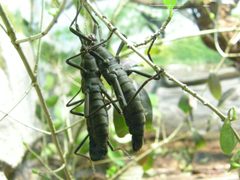
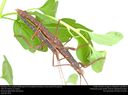
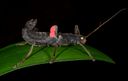
Pronunciation
How to pronounce Pseudophasmatidae: //ˌsjuːdəʊˌfæsˈmætɪdiː//
These audio files are automatically generated. While they are not always 100% accurate, they are a good starting point.
Identification
The defining diagnostic feature is the relative proportions of the thoracic segments: the is never more than three times the length of the prothorax. This distinguishes from other phasmid where the mesothorax may be proportionally longer. Many display longitudinal stripes (giving the ), though coloration varies considerably within species.
Images
Habitat
range from lowland forests to high montane environments. occur in tropical and subtropical regions including rainforests, dry scrublands, and cloud forests at elevations exceeding 2,000 meters in the Andes and Caribbean mountains.
Distribution
Native to the Americas from the southern United States through Central and South America, including the Caribbean (Greater Antilles, Bahamas). The Stratocleinae occurs in Central and South America and Malesia. Distribution records also indicate presence in Europe, Indian Subcontinent, Malesia, Australia, and Northern America, though these may represent introduced or data artifacts.
Diet
Herbivorous, feeding on foliage of trees and shrubs. Documented plants include crepe myrtle, roses, oaks, and rosemary. Some are .
Host Associations
- crepe myrtle - food plantAnisomorpha buprestoides
- roses - food plantAnisomorpha buprestoides
- oaks - food plantAnisomorpha buprestoides
- rosemary - food plantAnisomorpha buprestoides
Life Cycle
Hemimetabolous development with , nymph, and stages. typically occurs in the egg stage. Nymphs and adults are similar in appearance; adults of many are or brachypterous. Females often attain larger size through additional compared to males.
Behavior
through body form and swaying movement mimicking vegetation in wind. When disturbed, some discharge noxious, irritating secretions from thoracic glands. (voluntary leg loss) with subsequent has been documented. Mating pairs may remain coupled for extended periods.
Ecological Role
Herbivores that can occasionally reach densities and cause localized defoliation of trees and shrubs. Serve as prey for vertebrate and , with chemical defense and as anti-predator adaptations.
Human Relevance
Occasional defoliators of ornamental plants. Some , notably the two-striped walkingstick (Anisomorpha buprestoides), can spray defensive secretions causing severe irritation and pain in humans; handling requires caution.
Similar Taxa
- PhasmatidaeDifferentiated by proportions; has mesothorax ≤3× prothorax length, while Phasmatidae typically has more elongated mesothorax
- HeteropterygidaeBoth are Verophasmatodea but differ in body proportions and geographic distribution; Heteropterygidae are primarily Southeast Asian
More Details
Subfamily classification
Contains three : Pseudophasmatinae (Rehn, 1904), Stratocleinae (Günther, 1953) with single tribe Stratocleini in Central & South America and Malesia, and Xerosomatinae (Bradley & Galil, 1977)
Sexual size dimorphism
Females are typically substantially larger than males, a pattern attributed to selection favoring larger production in females, while males may benefit from rapid development and early maturation
Sources and further reading
- BugGuide
- Wikipedia
- GBIF taxonomy match
- iNaturalist taxon
- NCBI Taxonomy
- Catalogue of Life
- From the Bug of the Week mailbag: World’s largest walking stick visits the Goddard Space Flight Center, Northern walkingstick, Diapheromera fermorata — Bug of the Week
- Destination Hutchison Island, Florida: a visit with the Twostriped walkingstick, 'Anisomorpha buprestoides' — Bug of the Week
- Leg Regeneration Trade-Offs in the Twostriped Walkingstick (Phasmatodea: Pseudophasmatidae)
- New taxonomic and ecological data for Paraprisopus apterus, the smallest stick insect from French Guiana (Phasmatodea, Pseudophasmatidae, Paraprisopodini)
- Peruphasma marmoratum, a remarkable new species of high montane Phasmatodea (Pseudophasmatidae: Pseudophasmatinae) from the Venezuelan Andes
- Peruphasma marmoratum, a remarkable new species of high montane Phasmatodea (Pseudophasmatidae: Pseudophasmatinae) from the Venezuelan Andes
- Studies on neotropical Phasmatodea XV: A remarkable new stick insect from highly montane habitats of Hispaniola (Pseudophasmatidae: Xerosomatinae: Hesperophasmatini)
- Studies on neotropical Phasmatodea I: A remarkable new species of Peruphasma Conle & Hennemann, 2002 from Northern Peru (Phasmatodea: Pseudophasmatidae: Pseudophasmatinae)
- Studies on neotropical Phasmatodea II: Revision of the genus Malacomorpha Rehn, 1906, with the descriptions of seven new species (Phasmatodea: Pseudophasmatidae: Pseudophasmatinae)
- Survey of the Color Forms of the Southern Twostriped Walkingstick (Phasmatodea: Areolatae: Pseudophasmatidae: Pseudophasmatinae: Anisomorphini), With Notes on Its Range, Habitats, and Behaviors